
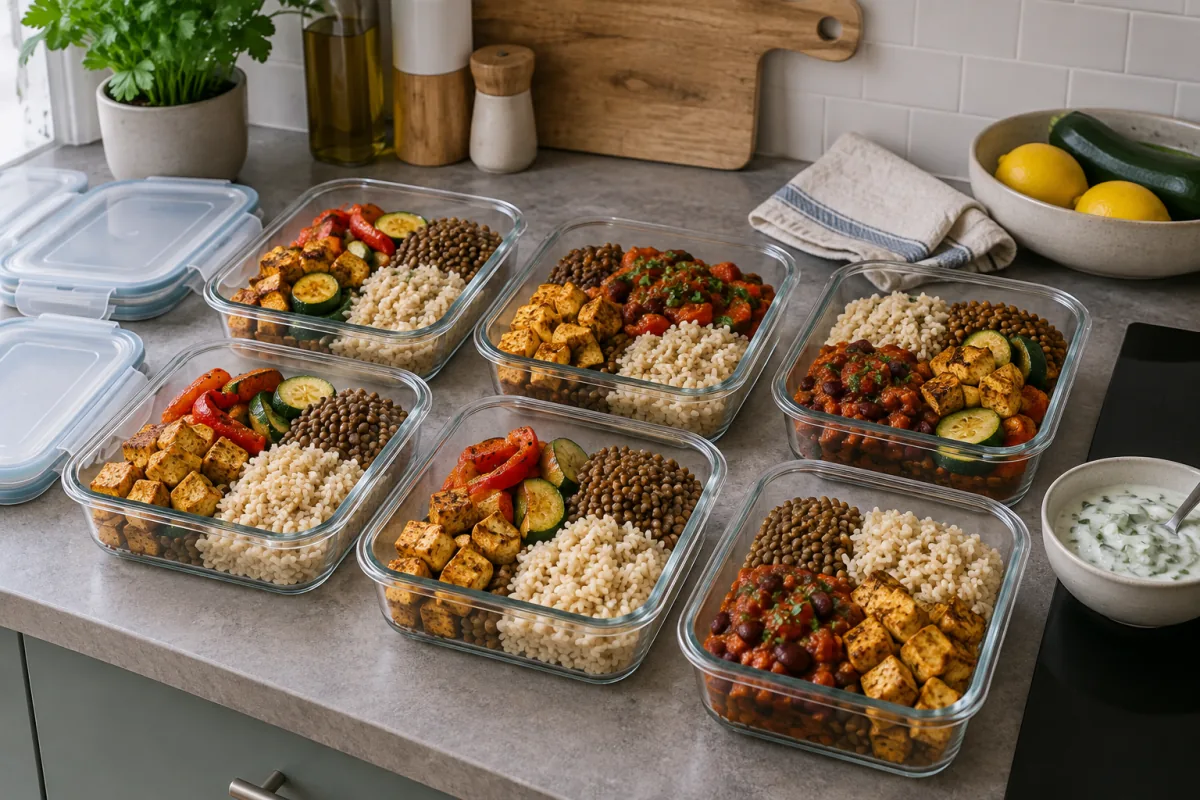
Meal prep for beginners works best when you cook two proteins, two grains and a tray of vegetables on Sunday, then assemble five lunches and five dinners from those parts across the week. It takes about two hours, costs less than buying lunch, and it means the question “what should I eat” is already answered when you are tired. Below is a first-week plan with a shopping list, the order to cook things in so nothing sits waiting, how long each dish keeps safely, and the mistakes that make most people quit after week one.
Table of Contents
- 1 Key takeaways
- 2 Pick a format first
- 3 The one-week plan
- 4 Shopping list grouped by aisle
- 5 Two-hour Sunday order of operations
- 6 Food safety: how long each dish keeps
- 7 Containers, reheating and what does not reheat well
- 8 Mistakes beginners make
- 8.1 Cooking seven days at once
- 8.2 Choosing new recipes for prep day
- 8.3 Making every meal identical
- 8.4 Skipping the freezer
- 8.5 Prepping the wrong meal
- 8.6 Who meal prep is not for
- 8.7 How many days can meal prep stay in the fridge?
- 8.8 Can I freeze cooked rice and pasta?
- 8.9 Do I have to eat the same thing every day?
- 8.10 Is meal prep cheaper than buying lunch?
Key takeaways
- Start with components, not full plated meals. Cooked chicken, rice, roasted vegetables and a sauce can become five different lunches.
- Cook only Monday to Friday. Weekends are for leftovers and eating out, and it keeps the job to two hours.
- Most cooked food keeps three to four days in the fridge. Freeze anything meant for Thursday or Friday.
- Buy six matching containers with tight lids before you buy any food.
- Cool food within two hours, then refrigerate. Reheat until steaming hot all the way through.
Pick a format first
There are three ways to prep, and picking the wrong one is why beginners burn out.
| Format | What you do | Best for | Downside |
|---|---|---|---|
| Batch cooking | Make one big dish (chilli, curry, soup) and portion it | Cheapest and fastest | Same meal five times |
| Components | Cook proteins, grains and vegetables separately, mix at mealtime | Variety, picky eaters, families | More containers, needs assembling |
| Full portions | Plate every meal into its own box, ready to reheat | People who will not assemble anything at work | Longest Sunday, food gets boring by Thursday |
For a first week, use components with one batch dish. It gives you variety without a long Sunday, and if a component fails (the rice is mushy, say) only part of the week is affected.
The one-week plan
Everything below comes from four cooked components plus one batch dish. Components: roasted chicken thighs (or baked tofu), a tray of roasted vegetables, a pot of rice, a pot of lentils. Batch dish: a vegetable and bean chilli. Two sauces tie it together: a yoghurt and lemon sauce, and a soy, ginger and sesame dressing.
| Day | Lunch | Dinner | Weekday effort |
|---|---|---|---|
| Monday | Chicken, rice and roasted veg bowl with yoghurt sauce | Chilli with rice and grated cheese | Reheat only |
| Tuesday | Lentil salad with roasted veg, feta and lemon | Chicken stir-fry: reheat chicken and veg with the soy dressing over rice | 5 minutes |
| Wednesday | Chilli in a wrap with salad leaves | Chicken and lentil soup: simmer lentils, chicken and veg in stock | 10 minutes |
| Thursday | Rice bowl with lentils, veg and a fried egg | Frozen chilli portion over a baked potato | Microwave plus oven |
| Friday | Chicken wrap with roasted veg and yoghurt sauce | Frozen chicken and rice portion with fresh salad | Reheat only |
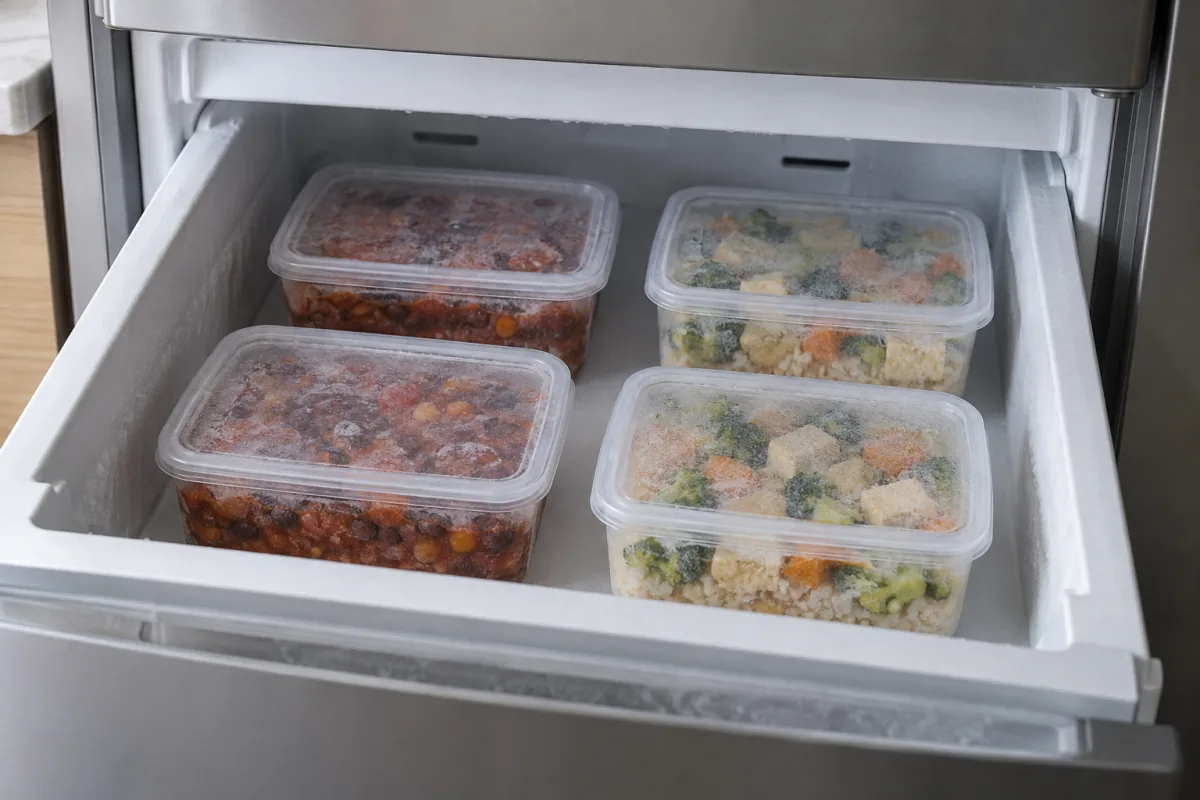
Thursday and Friday use frozen portions on purpose. Cooked chicken and rice should not sit in the fridge for five days, so on Sunday you box up two lunches and two dinners for the end of the week and freeze them straight away.
Shopping list grouped by aisle
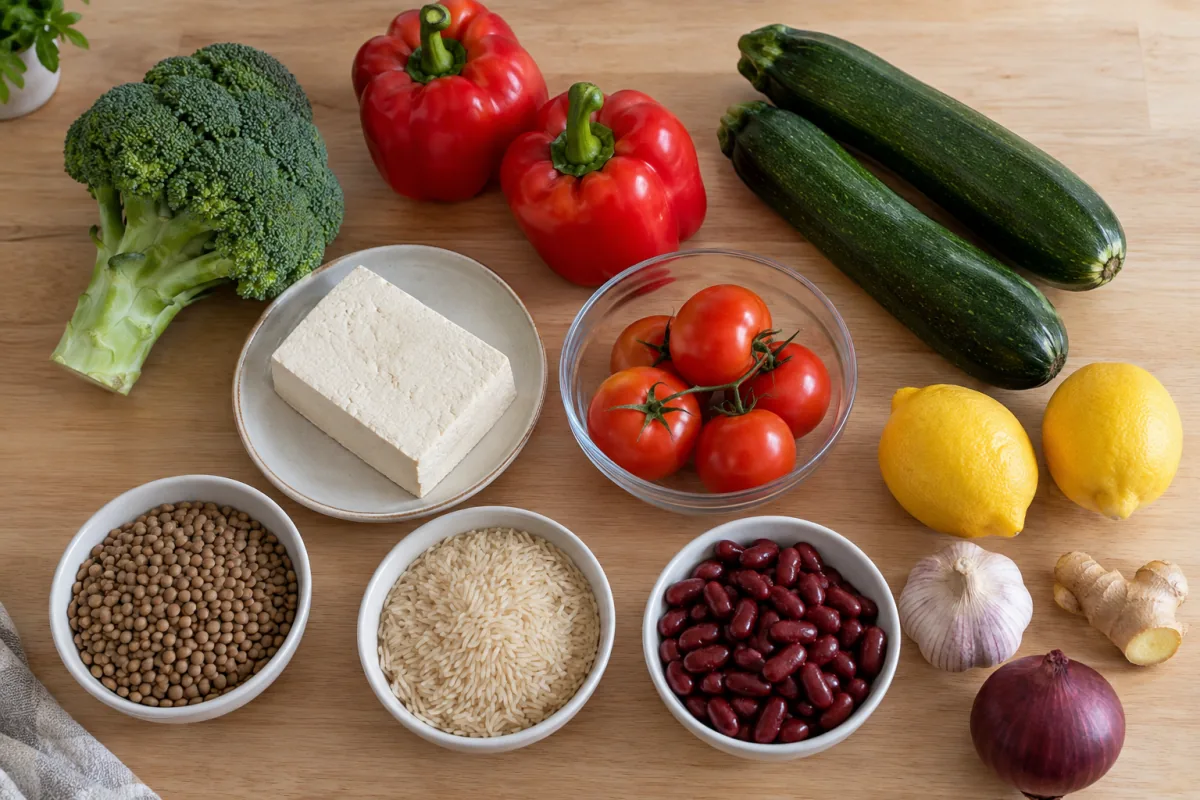
Quantities feed one person for five lunches and five dinners with a little left over. Double the proteins and grains for two people; the vegetables and pantry items stretch further than you would expect.
Meat, dairy and chilled
- 1 kg boneless chicken thighs, or 800 g firm tofu for a plant-based week
- 500 g plain Greek yoghurt
- 200 g feta or a hard cheese to grate
- 6 eggs
- 4 wholegrain wraps
Fruit and vegetables
- 2 red peppers, 2 courgettes, 1 large aubergine or 400 g mushrooms, 2 red onions
- 1 broccoli head
- 2 lemons, a thumb of ginger, a garlic bulb
- 1 bag salad leaves, 4 medium potatoes
Pantry
- 500 g basmati or long-grain rice
- 400 g dried green or brown lentils (or 3 tins)
- 2 tins kidney or black beans, 2 tins chopped tomatoes
- Olive oil, soy sauce, sesame oil, cumin, smoked paprika, chilli flakes, stock cubes, salt and pepper
If you eat Mediterranean-style already, our Mediterranean diet grocery list overlaps with this almost completely and adds fish and olives for variety in week two.
Two-hour Sunday order of operations
The trick is to start the slow things first and never stand waiting for one thing to finish.
- 0:00. Oven on at 200°C. Chop vegetables for roasting, toss with oil, salt and paprika, spread on two trays. In.
- 0:10. Season chicken thighs with cumin, garlic, lemon and oil. Onto a third tray. In. (Tofu: press, cube, oil and cornflour, same tray time.)
- 0:15. Rinse rice, put on to cook. Rinse lentils, put on to simmer in salted water with a bay leaf.
- 0:20. Start the chilli: onion, garlic and peppers in a large pot, then spices, tomatoes, beans, a splash of water. Leave it to bubble for 30 minutes, stirring now and then.
- 0:35. Rice done. Spread it on a tray to cool fast. This matters for food safety, see the next section.
- 0:45. Vegetables and chicken out of the oven. Lentils drained. Leave everything uncovered to cool.
- 0:50. Make the two sauces. Yoghurt, lemon juice, garlic, salt. Soy, sesame oil, grated ginger, a little honey.
- 1:00. Chilli done. Cool it in a shallow dish.
- 1:20 to 1:45. Portion into containers. Fridge boxes for Monday to Wednesday, freezer boxes for Thursday and Friday, labelled with the dish and the date.
- 1:45 to 2:00. Wash up. Done.
Food safety: how long each dish keeps
This is the part beginners skip and then wonder why they felt off on Thursday. The rules are simple and the same for every dish.
- Cool cooked food within two hours, then refrigerate. Spreading rice and chilli in shallow trays gets them cold fast. Do not put a big hot pot straight in the fridge; it warms everything around it.
- Keep the fridge at 5°C or below. A cheap fridge thermometer is worth buying.
- Reheat once, until steaming hot right through. Do not reheat the same portion twice.
- Thaw frozen portions in the fridge overnight, not on the counter.
| Dish | Fridge | Freezer |
|---|---|---|
| Cooked chicken | 3 to 4 days | 2 to 6 months |
| Cooked tofu | 3 to 5 days | 3 months |
| Cooked rice | Eat within 1 day (cool within 1 hour) | 1 month |
| Cooked lentils | 3 to 5 days | 3 months |
| Roasted vegetables | 3 to 4 days | Texture suffers, 1 month |
| Bean chilli | 3 to 4 days | 3 months |
| Yoghurt sauce | 3 days | Do not freeze |
Rice deserves its own warning. Uncooked rice can carry spores of a bacterium that survive cooking and multiply if the cooked rice sits at room temperature. The NHS advice on reheating rice is to cool it within an hour, refrigerate, and eat within one day. For a five-day plan that means either cooking rice twice (Sunday and Wednesday) or freezing Tuesday’s portion onward and thawing the night before. The FDA storage guidance covers the general fridge and freezer times used in the table.
Containers, reheating and what does not reheat well
Buy six identical containers of about 1 litre with clip lids. Glass is heavier but does not stain or hold smells and goes from freezer to oven. Plastic is lighter for carrying to work. Either way, matching boxes stack, and stacking is what keeps a small fridge usable.
Keep wet and dry apart. Sauce goes in a small separate pot, salad leaves go in last or in their own bag, and anything crisp (roasted chickpeas, nuts, croutons) travels separately and is added at the desk.
Some things simply do not survive a microwave:
- Salad leaves, cucumber and fresh tomato. Add fresh.
- Fried eggs and scrambled eggs go rubbery. Cook them on the day; it takes three minutes.
- Pasta with a cream sauce splits. Tomato-based pasta reheats fine.
- Avocado browns. Halve it the morning you need it.
- Crispy anything goes soft. Reheat in an oven or air fryer instead if you can.
Reheat with a splash of water and the lid loosely on. Rice and lentils dry out otherwise. Stir halfway.
Mistakes beginners make
Cooking seven days at once
By Saturday the food is either unsafe or unappealing. Five days is the limit, and the last two days should come from the freezer.
Choosing new recipes for prep day
Sunday is not the day to attempt something you have never made. Cook things you can do without thinking, then experiment in week three.
Making every meal identical
Batch cooking fails when the tenth bowl of the same chilli goes in the bin. Components with two sauces are the fix. Change one element (a sauce, a fresh topping, a wrap instead of a bowl) and it reads as a different meal.
Skipping the freezer
The freezer is what makes weeks two and three easier than week one. Every Sunday, freeze two extra portions. Within a month you have a bank of ready meals for the week you cannot cook at all.
Prepping the wrong meal
If breakfast is where your day falls apart, prep breakfast. Overnight oats and boiled eggs take ten minutes to prepare for the whole week. If late evenings are the problem, the answer may not be more food in boxes; read about stopping late-night stress eating first.
Who meal prep is not for
If you genuinely enjoy cooking each evening and have the time, you do not need this. If you have a history of disordered eating, rigid pre-portioned meals can feed the problem; a dietitian or your doctor can suggest a looser approach. And if you have no freezer and a shared fridge, stick to two or three days of prep rather than five.
Frequently asked questions
How many days can meal prep stay in the fridge?
Three to four days for most cooked dishes, and one day for cooked rice unless it is frozen. Anything for day four or five should go straight into the freezer on Sunday and be thawed in the fridge the night before.
Can I freeze cooked rice and pasta?
Yes. Cool rice quickly, portion it flat in bags or boxes, and freeze within an hour of cooking. It reheats well from frozen in the microwave with a splash of water. Pasta freezes acceptably if slightly undercooked first; tomato sauces freeze better than cream ones.
Do I have to eat the same thing every day?
No. That is the point of prepping components rather than full meals. The same chicken, rice and vegetables become a bowl, a wrap, a stir-fry and a soup during the week depending on the sauce and how you heat them.
Is meal prep cheaper than buying lunch?
Usually, and by a wide margin. The shopping list above comes to a fraction of what five bought lunches and five takeaway dinners cost in most cities, and it covers ten meals. The saving is largest when you buy dried lentils and rice in bulk and choose the vegetables that are in season. Quick breakfasts help too; see our 10-minute anti-inflammatory breakfasts for options that need no prep at all.