

Zone 2 cardio is steady exercise at roughly 60 to 70 percent of your maximum heart rate, a pace where you can hold a conversation in full sentences but would not want to sing. For most adults that means a brisk walk on a hill, an easy bike ride, or a slow jog that feels almost too easy. It is the intensity that builds the base of your fitness: your heart pumps more blood per beat, your muscles get better at burning fat for fuel, and your resting heart rate drops. You do not need a watch to find it. This article shows three ways to locate your zone, how long and how often a beginner should train there, and what to expect after six weeks.
Table of Contents
Key takeaways
- Zone 2 is 60 to 70 percent of your maximum heart rate. Estimate max heart rate as 220 minus your age, then take 60 to 70 percent of that.
- The talk test works as well as a watch for beginners: full sentences yes, singing no.
- Start with three sessions of 20 to 30 minutes a week and build to 150 minutes or more over six weeks.
- Incline walking, cycling, rowing and swimming all count. Pick the one you will keep doing.
- The most common mistake is going too hard. If you are breathing through your mouth and cannot chat, slow down.
What zone 2 means
Coaches divide exercise intensity into five heart-rate zones. Zone 1 is very light, the sort of effort you barely notice. Zone 5 is an all-out sprint you can hold for a minute or two. Zone 2 sits near the bottom: hard enough that your body has to adapt, easy enough that you could keep going for an hour and recover by tomorrow.
Physiologically, zone 2 is the highest intensity at which your muscles are still mainly burning fat and clearing the by-products of exercise as fast as they are produced. Train there regularly and your body builds more of the machinery that does this work: more capillaries, more mitochondria in the muscle cells, a stronger heart.
The simplest way to describe the feeling: it should seem too easy for the first ten minutes. If you finish a session thinking you could have gone on, you did it right.
Three ways to find your zone
1. The formula
Estimate your maximum heart rate as 220 minus your age. Zone 2 is 60 to 70 percent of that number.
| Age | Estimated max heart rate | Zone 2 range (beats per minute) |
|---|---|---|
| 25 | 195 | 117 to 137 |
| 35 | 185 | 111 to 130 |
| 45 | 175 | 105 to 123 |
| 55 | 165 | 99 to 116 |
| 65 | 155 | 93 to 109 |
The formula is an average, and real maximum heart rates vary by 10 to 15 beats either way between people of the same age. Treat the numbers as a starting point and let the talk test correct them. The CDC’s guide to target heart rate uses the same calculation and defines moderate intensity as 64 to 76 percent of max, which overlaps with zone 2 at the lower end.
2. The talk test
Say a full sentence out loud while you exercise, something like “I am walking up this hill and it feels fine.” If it comes out in one go with normal breathing between sentences, you are in zone 2 or below. If you have to break it into short phrases, you have drifted into zone 3. If you could comfortably sing it, speed up a little. Research on the talk test shows it lines up closely with the point where breathing starts to change, which is exactly the top of zone 2.
3. A watch or chest strap
A wrist-based watch is fine for zone 2 because the pace is steady and the sensor has time to settle. Chest straps are more accurate during changes of pace but unnecessary for beginners. Set the watch to display current heart rate and use the formula range as your target.
Do the talk test alongside the watch for the first few sessions. If the watch says 128 and you can still chat easily, your real zone is higher than the formula suggests. Adjust the number, not the effort.
How long and how often: a six-week plan
Zone 2 rewards total time more than any single session. Start with what you can recover from and add ten percent a week. The WHO physical activity guidelines recommend 150 to 300 minutes of moderate activity a week for adults, and this plan gets a beginner to the lower end of that by week six.
| Week | Sessions | Minutes per session | Weekly total |
|---|---|---|---|
| 1 | 3 | 20 | 60 |
| 2 | 3 | 25 | 75 |
| 3 | 3 | 30 | 90 |
| 4 | 4 | 30 | 120 |
| 5 | 4 | 35 | 140 |
| 6 | 4 | 40 | 160 |
Include a five-minute warm-up walk at the start and a slower five minutes at the end within those times. If a week feels hard, repeat it rather than moving on. If you already walk a lot, start at week 3. If you have not exercised in years, read starting exercise when out of shape first and treat week 1 as two sessions of 15 minutes.
After week six, keep adding time slowly or hold at 150 to 180 minutes a week. Many people settle at three sessions of 45 to 60 minutes. Beyond that, adding a short harder session once a week gives more than adding still more zone 2.
Best activities for zone 2
The right activity is the one where you can control the effort and that you will do again on Thursday.
- Incline walking. For most beginners, flat walking does not raise the heart rate enough, but a hill or a treadmill at 5 to 10 percent incline does. This is the easiest place to start and gentle on the joints. If you are already walking daily, see what 30 minutes of walking a day does and add incline to move it into zone 2.
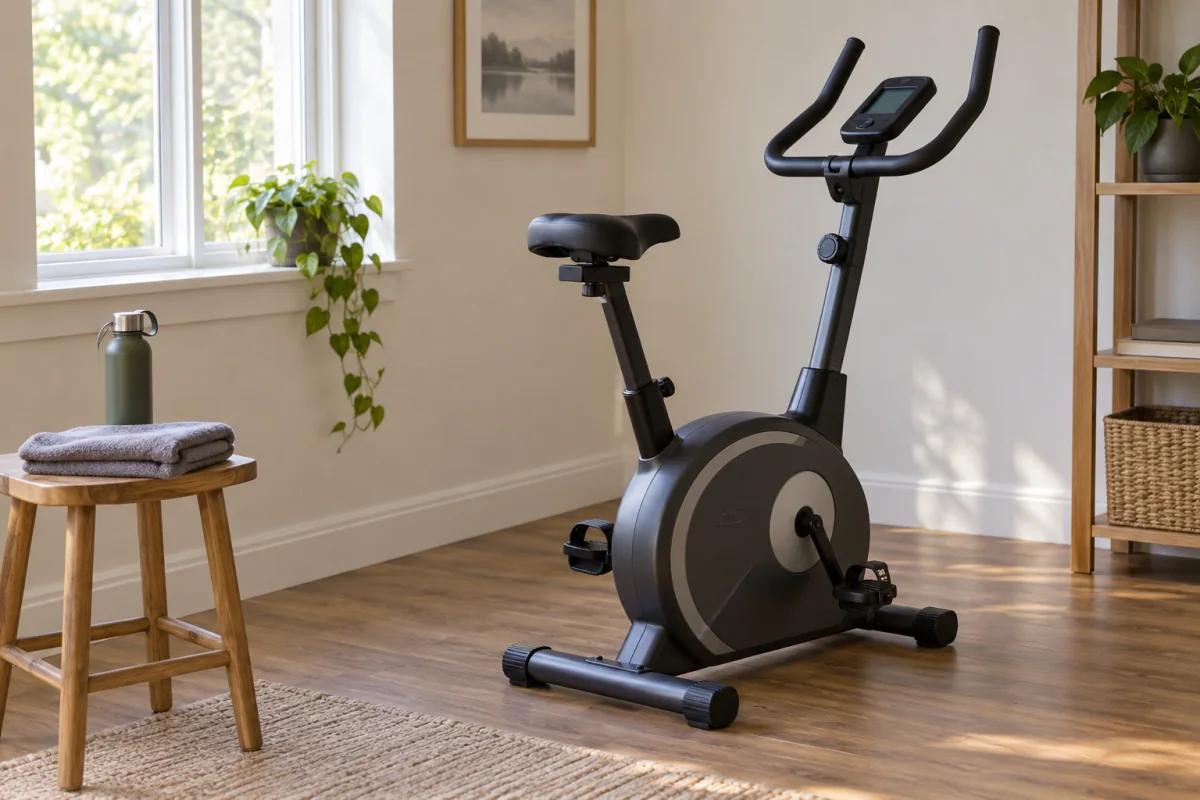
- Cycling. Easy to hold a steady effort, no impact, and an exercise bike lets you watch a screen. Keep the cadence high and the resistance low.
- Rowing. Works the whole body and is easy to keep steady on a machine. Technique matters; learn the sequence (legs, then back, then arms) before you add time.
- Swimming. Good for anyone with joint pain. Heart rate reads lower in water, so rely on the talk test at the end of each length rather than a watch.
- Slow jogging. Only if you can jog and still talk. Most beginners cannot yet, and that is normal. Walk-jog intervals get you there.

What changes and when
The changes come in a predictable order, and knowing the order stops you quitting in week three because nothing obvious has happened.
- Weeks 1 to 2: sessions feel easier by the end of the second week. This is mostly your nervous system learning the movement, not fitness yet.
- Weeks 3 to 6: the same pace produces a lower heart rate. A walk that put you at 125 beats per minute now sits at 115. This is the first real sign your heart is pumping more per beat.
- Weeks 6 to 12: resting heart rate falls, often by 5 to 10 beats per minute in people who were previously inactive. You recover faster between efforts and daily tasks feel lighter.
- Months 3 to 6: endurance changes substantially. An hour becomes routine. If you also lift weights or do harder intervals, they improve because you recover between sets faster.
What zone 2 does not do quickly is change the number on the scale. It burns a moderate number of calories per session and a large number over months, but it does not override what you eat. If fat loss is the goal, the eating side matters more; our piece on losing belly fat without a gym puts zone 2 in that context. Mayo Clinic’s page on exercise intensity is a good plain-language summary of why moderate effort, done consistently, delivers most of the health benefit of exercise.
Common mistakes
Going too hard
This is the big one. Zone 2 feels unproductive to people used to the idea that exercise should hurt, so they drift up to zone 3 or 4, finish tired, and cannot repeat it tomorrow. Zone 3 is not useless, but it costs more recovery for a similar aerobic benefit. If you cannot talk, slow down, even if that means walking when you wanted to jog.
Judging by sweat
Sweat depends on temperature, humidity, clothing and how well trained you are. It says nothing about which zone you are in. A cool morning walk in zone 2 might leave you dry; a hot afternoon in zone 1 might soak your shirt.
Trusting the watch over the body
Optical sensors misread on hairy wrists, under loose straps, in cold weather and on rowing machines. If the number and the feeling disagree, believe the feeling.
Skipping weeks and then doubling up
Missing a session is fine. Doing two long ones back to back to catch up is how beginners get shin pain and lose a fortnight. Just continue the plan from where you are.
Who should check with a doctor first
Zone 2 is low-risk for most people, which is one of its strengths. Still, get a doctor’s go-ahead before starting if any of these apply:
- You have a heart condition, have had chest pain, or have been told you have high blood pressure that is not controlled.
- You take a beta blocker or another medicine that lowers heart rate. The formula will not apply to you and the talk test is the only reliable guide.
- You have diabetes and use insulin, since exercise changes how much you need.
- You have joint problems, are pregnant, or are over 60 and have not exercised for a long time.
- You feel dizzy, get chest tightness, or are unusually breathless during easy exercise. Stop and get that checked.
This article is general information and cannot account for your own history. A doctor who knows it can tell you which activities suit you and whether any heart-rate target should be adjusted.
Frequently asked questions
Is walking zone 2 cardio?
It can be. For an unfit beginner, a brisk flat walk may reach zone 2. For most people it takes a hill, a treadmill incline or a fast pace to get the heart rate to 60 percent of max. Use the talk test: if a flat walk feels like nothing, it is probably zone 1.
How many minutes of zone 2 per week?
Aim for 150 minutes a week as a first target, in three to four sessions. That matches public health guidance for moderate activity. Once that is routine, 180 to 240 minutes gives further gains. There is no need for beginners to go beyond that.
Can I do zone 2 every day?
Yes, if the sessions are genuinely easy and you are sleeping and eating well. Because the intensity is low, recovery is quick. Most beginners do better with a rest day between sessions for the first month, then move to five or six days if they enjoy it.
Do I need a heart-rate monitor?
No. The talk test is enough to find and hold zone 2. A watch is useful later for tracking the drop in heart rate at a fixed pace, which is the clearest sign of progress, but it is a nice-to-have, not a requirement.