

If you are completely out of shape, the way to start working out is to begin far below what you think you should be doing. Ten minutes of walking, a handful of chair squats, done four days this week. Not a 45-minute class. Not a running plan. The goal of month one is not fitness. It is turning up often enough that turning up becomes normal. This guide gives you a four-week starting plan, the numbers to aim for, the mistakes that end most attempts by week three, and the signs that mean you should check with a doctor first.
Table of Contents
- 1 Key takeaways
- 2 Check before you start
- 3 Why starting small works better than starting hard
- 4 The four-week starting plan
- 5 How hard is hard enough?
- 6 Soreness versus pain
- 7 The mistakes that end most attempts
- 8 What progress looks like at 4, 8 and 12 weeks
- 9 Handling the desk-job body
- 10 Making it stick
- 11 Who this plan is not for
Key takeaways
- Start with 10 minutes of easy movement, four days a week. Add time before you add intensity.
- Walking, bodyweight moves and light stretching are enough for the first month.
- Soreness is normal. Sharp pain, chest pain, dizziness or breathlessness at rest are not.
- Consistency beats effort. Three easy sessions you complete beat one hard session you dread.
- The WHO target of 150 minutes a week is the destination, not the starting line.
Check before you start
Most healthy adults can begin light exercise without seeing a doctor. Talk to one first if you have heart disease, high blood pressure that is not controlled, diabetes, joint problems that limit movement, are pregnant, are over 60 and have been inactive for years, or get chest pain or dizziness with mild effort. This is not a formality. It gives you a safe starting point and often a clearer idea of what you can do than you expect.
The World Health Organization recommends 150 to 300 minutes of moderate activity a week for adults, with strength work twice a week. Keep that number in mind as a target for month three or four. Trying to hit it in week one is the most common reason beginners quit.
Why starting small works better than starting hard
A body that has been inactive for years adapts fast, but the tendons, ligaments and joints adapt more slowly than the heart and lungs. That gap is where injuries come from. Your cardiovascular system may feel ready for a 5K by week three. Your knees are not.
There is also the habit problem. Motivation runs out. A session so easy that you have no excuse to skip it survives a bad day. A session that requires courage does not. Ten minutes is the amount most people can do on their worst day, so that is where you start.
The four-week starting plan
Four sessions a week, on non-consecutive days if possible. Every session begins with two minutes of gentle marching on the spot and arm circles, and ends with two minutes of slow walking.
Week 1: 10 minutes
- Walk at a comfortable pace for 8 minutes. You should be able to talk in full sentences.
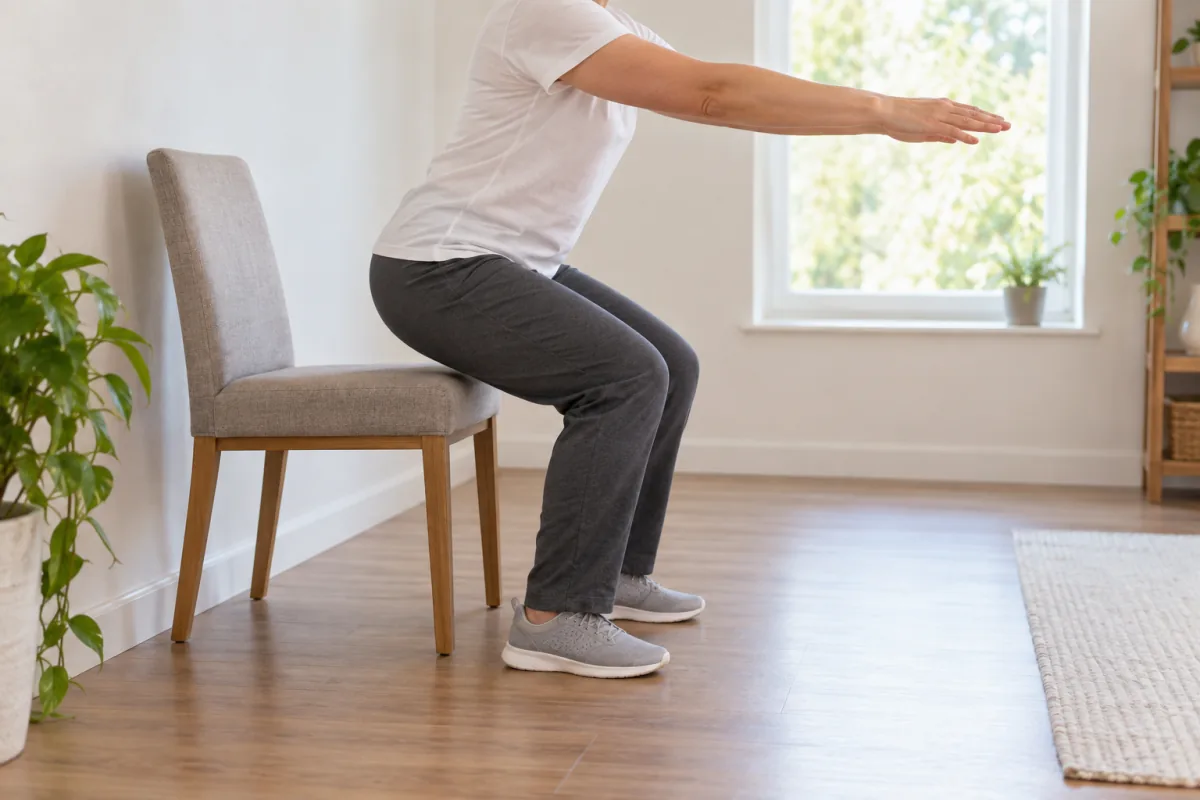
- Then do 5 chair squats (sit down slowly, stand up) and 5 wall push-ups.
Week 2: 15 minutes
- Walk for 12 minutes. Include one or two 30-second stretches where you walk a little faster.
- Chair squats and wall push-ups, 8 each. Add 20 seconds of standing on one leg per side, holding a wall.
Week 3: 20 minutes
- Walk for 15 minutes with three or four 30-second faster stretches.
- Two rounds of: 8 chair squats, 8 wall push-ups, 10 standing knee lifts per side.
Week 4: 25 minutes
- Walk for 18 minutes. Try one 1-minute faster stretch.
- Two rounds of: 10 squats (chair optional), 10 incline push-ups on a kitchen counter, 10 knee lifts per side, 20-second plank on knees.
If a week feels too hard, repeat it. There is no prize for finishing the plan on schedule. If it feels too easy, resist the urge to jump ahead more than one week. The joints are still catching up.
How hard is hard enough?
Use the talk test. Moderate effort means you can talk but not sing. Vigorous means you can only manage a few words. For the whole first month, stay at moderate. Beginners who go straight to vigorous get sore, sometimes injured and almost always discouraged.
| Effort level | Talk test | Use in month one? |
|---|---|---|
| Light | Can talk and sing easily | Warm-up and cool-down |
| Moderate | Can talk, cannot sing | Yes, most of every session |
| Vigorous | A few words at a time | Only the short faster stretches |
| Maximal | Cannot speak | No |
Soreness versus pain
Muscle soreness that arrives 24 to 48 hours after a session, feels like a dull ache, and eases with gentle movement is normal. It usually disappears after the first two weeks. Pain that is sharp, located in a joint, appears during the exercise, gets worse as you continue or causes swelling is not normal. Stop and rest, and see a doctor if it lasts more than a few days. Stop immediately and seek help for chest pain, pain spreading to the arm or jaw, faintness, or breathlessness out of proportion to the effort.

The mistakes that end most attempts
- Starting with a plan built for someone else. Couch-to-5K programmes and gym classes assume a baseline you may not have yet. Build the baseline first.
- All or nothing. Missing Tuesday does not mean the week is ruined. Do Wednesday.
- Chasing the scale. Weight often does not move in month one, because fitness gains come before fat loss. Judge progress by how the stairs feel.
- Buying gear before building the habit. Comfortable shoes are the only real requirement. Everything else can wait.
- Doing the same thing every day. Rest days are when your body adapts. Four days on, three off is plenty.
- Ignoring sleep and food. Exercise on four hours of sleep feels twice as hard. You do not need a special diet, but you do need enough protein and regular meals.
What progress looks like at 4, 8 and 12 weeks
- Week 4: A flight of stairs no longer leaves you breathless. You sleep a little deeper. Sessions feel routine rather than heroic.
- Week 8: You are walking 30 minutes at a brisk pace and can do full squats and counter push-ups without thinking about it. Resting heart rate is a few beats lower. Our guide to what 30 minutes of daily walking does covers this stage.
- Week 12: You are close to the 150-minute weekly target and ready for structured strength training, a beginner running plan or a class. This is where most “beginner” programmes should actually begin.
Handling the desk-job body
If you sit most of the day, tight hips, a stiff upper back and rounded shoulders will make some moves feel awkward at first. Add five minutes of the stretches from our desk worker stretching guide to the end of each session. If your shoulders roll forward from phone use, this posture guide pairs well with the push-up progression. For a gentle start on flexibility, a beginner morning yoga routine fits on rest days.
Making it stick
Habits form around cues, not willpower. Tie each session to something that already happens: after the morning tea, straight after work before you sit down, or during a child’s football practice. Put your shoes by the door the night before. Track sessions on a paper calendar with a single tick, and aim for four ticks a week rather than a perfect run. If you miss a week entirely, go back to the previous week’s plan rather than starting from zero. Telling one person what you are doing roughly doubles the odds that you keep going. A walking partner is even better, because a cancelled walk lets someone else down.
Who this plan is not for
This plan is for adults who are inactive but otherwise well. It is not designed for people recovering from surgery, living with a heart or lung condition, managing severe obesity with joint pain, pregnant, or over 65 with balance concerns. Those situations need a plan from a doctor or physiotherapist, and often a referral to supervised exercise. The NHS activity guidelines include separate advice for older adults and for people with disabilities. If in doubt, ask.
Frequently asked questions
How many days a week should a complete beginner work out?
Three to four short sessions a week is enough. Rest days matter as much as training days in the first month.
Is walking enough to get in shape?
For the first one to two months, yes, combined with a few bodyweight moves. After that, adding strength work and some faster intervals keeps progress going.
How long until I see results?
Energy and sleep often improve within two weeks. Stamina improves noticeably by week four. Visible body changes usually take eight to twelve weeks.
Should I be sore after every workout?
No. Some soreness in the first two weeks is normal. Constant soreness means you are doing too much too soon.
Do I need a gym?
Not for this plan. Everything here can be done at home or outdoors with a chair, a wall and a pair of comfortable shoes.
What if I am very overweight?
Start with shorter walks and seated or wall-based moves, and check with a doctor if you have joint pain or breathlessness. Water-based exercise is easier on the joints and worth considering.