
If you sit at a desk for most of the day, the best stretches are the ones that target what sitting does: it shortens the hip flexors, tightens the chest and the back of the neck, and switches off the glutes and upper back. This guide gives you a daily routine of ten stretches that takes about eight minutes, split into a morning set, a two-minute desk set you can do in a shirt and tie, and an evening set for the hips. Each one has the hold time, the reps and the mistake people most often make with it.
Table of Contents
- 1 Key takeaways
- 2 What sitting does to your body
- 3 Morning set: 3 minutes before you sit down
- 4 Desk set: 2 minutes every 45 minutes
- 5 Evening set: 3 minutes for the hips and back
- 6 The full routine at a glance
- 7 Add two strength moves or the tightness comes back
- 8 Set up the desk so you stretch less
- 9 Common mistakes
- 10 Who should check with a doctor first
Key takeaways
- Sitting tightens the front of the hips and chest and weakens the back of the body. Stretches should reverse that pattern.
- Hold each stretch 20 to 30 seconds and breathe. Bouncing does not help.
- Two-minute breaks every 45 minutes matter more than one long session.
- Pair stretching with a few strength moves for the glutes and upper back, or the tightness returns.
- Numbness, tingling or pain that travels down a leg or arm is a reason to see a doctor, not to stretch harder.
What sitting does to your body
A seated posture puts the hips at roughly 90 degrees, which keeps the hip flexors at the front of the hip in a shortened position for hours. Over months they adapt to that length. When you stand up, they pull the pelvis forward, which increases the arch in the lower back and is one of the most common contributors to the dull ache desk workers feel at 4pm.
At the same time, the arms reach forward to a keyboard, which shortens the chest muscles, and the head drifts towards the screen, which loads the muscles at the back of the neck. Meanwhile the glutes, which should be your biggest and strongest muscles, spend eight hours doing nothing. The NHS guide to posture mistakes describes the resulting shape as a combination of slouching, rounded shoulders and a forward head.
Stretching alone cannot fix this, because muscles that have been switched off need to be switched back on. But stretching is the fastest way to relieve the daily stiffness, and it makes the strength work possible.
Morning set: 3 minutes before you sit down
1. Standing hip flexor stretch
Step one foot forward into a lunge, back knee slightly bent, and tuck your pelvis under as if pulling your belt buckle towards your chin. You should feel it at the front of the back hip, not in the lower back. Hold 30 seconds each side. Common mistake: arching the lower back instead of tucking the pelvis, which removes the stretch entirely.
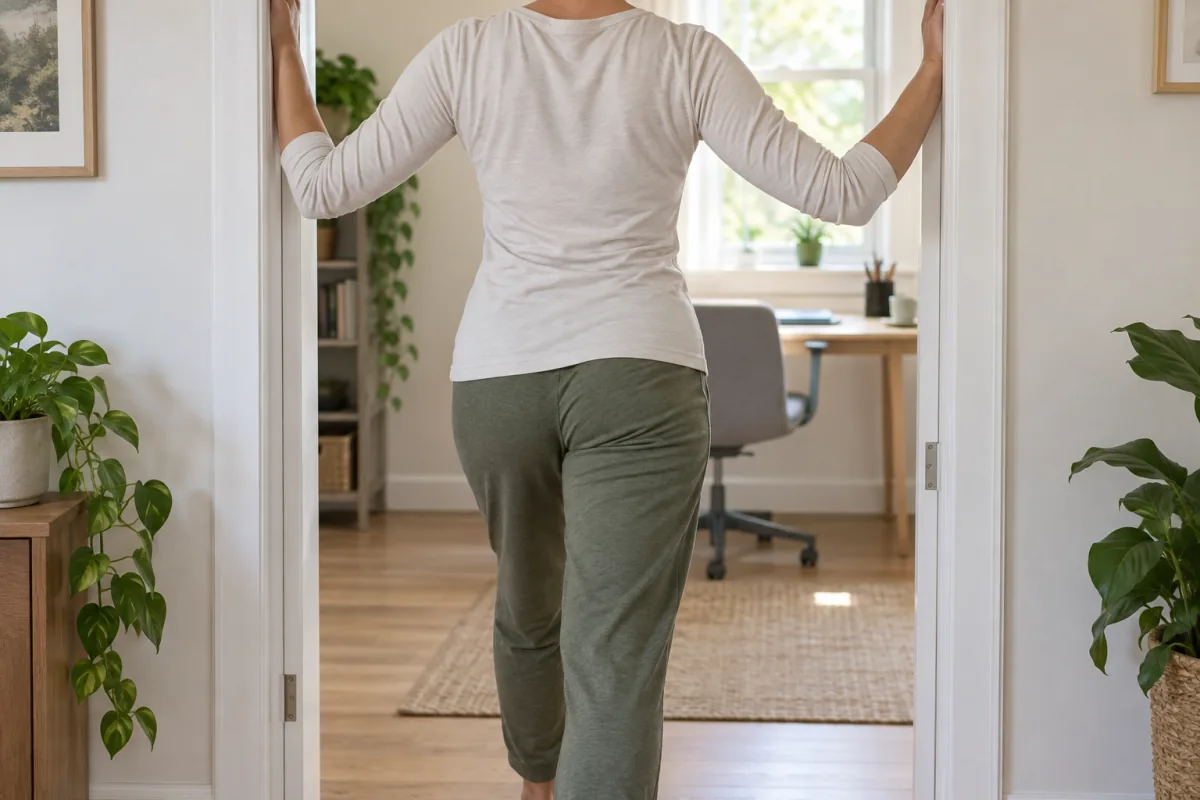
2. Doorway chest stretch
Forearms on either side of a door frame, elbows at shoulder height. Step through until the chest opens. Hold 30 seconds, twice. Mistake: shrugging the shoulders up towards the ears. Keep them down.
3. Cat-cow
On hands and knees, arch the spine towards the ceiling on the out-breath and let it sag towards the floor on the in-breath. Ten slow cycles. This is a mobility move rather than a stretch, and it wakes up the whole spine before the day loads it.
Desk set: 2 minutes every 45 minutes
These can be done in work clothes without leaving your chair. Set a timer. The frequency is the point.
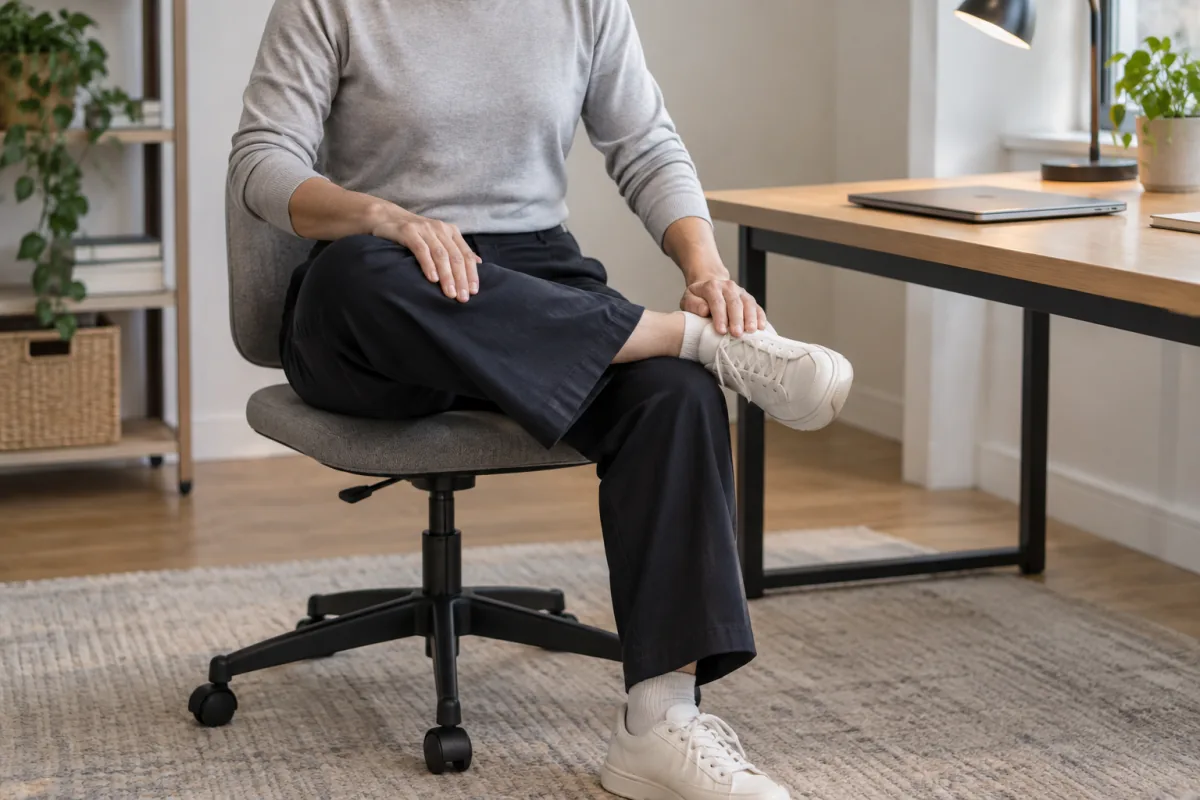
4. Seated figure-four
Sit tall, cross your right ankle over your left knee, and lean forward from the hips until you feel a stretch deep in the right buttock. Hold 20 to 30 seconds each side. This targets the piriformis and outer hip, which tighten in a chair and can irritate the sciatic nerve.
5. Seated spinal twist
Sit tall, place your right hand on the outside of your left knee and your left hand on the chair behind you. Turn gently to the left, leading with the chest, not the neck. Hold 20 seconds each side. Mistake: twisting from the lower back with a rounded spine. Sit up first, then turn.
6. Chin tucks and neck side bends
Draw the chin straight back, hold 5 seconds, release. Do 8. Then tilt the head to one side, ear towards shoulder, and hold 20 seconds each way. These unload the upper trapezius and the muscles at the base of the skull that ache after a long screen session.
7. Standing shoulder rolls and wall angels
Stand, roll the shoulders up, back and down five times. If there is a wall nearby, stand against it with arms in a goalpost shape and slide them up and down eight times. This is as much a strengthening move for the upper back as a stretch.
Evening set: 3 minutes for the hips and back
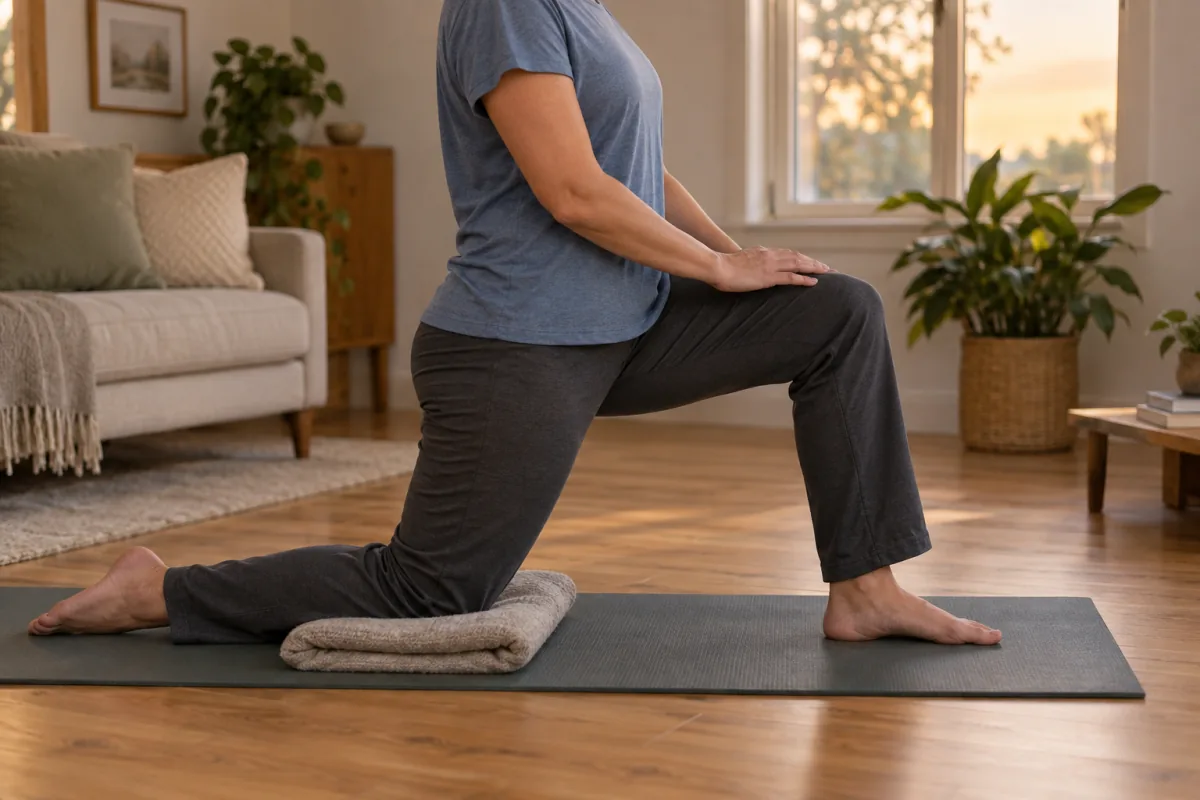
8. Kneeling hip flexor stretch
Kneel on one knee with a cushion under it, the other foot forward. Tuck the pelvis and shift slightly forward. Raise the arm on the kneeling side overhead to deepen it. Hold 30 to 45 seconds each side. This is the most important stretch on the list for anyone with a desk-related lower back ache.
9. Lying glute stretch
Lie on your back, cross one ankle over the opposite knee, and pull the supporting thigh towards you. Hold 30 seconds each side. Easier on the back than the seated version, so it suits the end of the day.
10. Child’s pose with side reach
From kneeling, sit back on your heels and reach the arms forward along the floor. Walk both hands to the right for 20 seconds, then to the left. This lengthens the lats and the sides of the back that stiffen from reaching forward all day.
The full routine at a glance
| When | Stretch | Hold or reps | Target |
|---|---|---|---|
| Morning | Standing hip flexor | 30 s each side | Front of hip |
| Morning | Doorway chest | 2 x 30 s | Chest, front shoulder |
| Morning | Cat-cow | 10 cycles | Whole spine |
| Desk | Seated figure-four | 20 to 30 s each | Glutes, piriformis |
| Desk | Seated twist | 20 s each | Mid back |
| Desk | Chin tucks, side bends | 8 tucks, 20 s each | Neck |
| Desk | Shoulder rolls, wall angels | 5 rolls, 8 angels | Upper back |
| Evening | Kneeling hip flexor | 30 to 45 s each | Front of hip, lower back |
| Evening | Lying glute | 30 s each | Glutes |
| Evening | Child’s pose with reach | 20 s each side | Lats, sides |
Add two strength moves or the tightness comes back
Stretching a muscle that is tight because its opposite is weak gives relief for a few hours. To make the change last, add these twice a day. They take under a minute.
- Glute bridges. Lie on your back, knees bent, and lift the hips by squeezing the glutes. Hold 2 seconds at the top. 12 reps. If you feel it in the hamstrings or lower back rather than the buttocks, move the feet closer to you.
- Scapular squeezes. Standing or seated, draw the shoulder blades back and down. Hold 5 seconds. 10 reps.
For a fuller programme for the upper body, see our guide on fixing rounded shoulders. If you are new to exercise altogether, this beginner’s plan builds up gradually alongside the stretches.
Set up the desk so you stretch less
- Top of the screen at eye level, about an arm’s length away.
- Elbows at roughly 90 degrees, wrists straight, shoulders relaxed.
- Feet flat on the floor or a footrest, knees level with or slightly below the hips.
- Stand for phone calls. If you have a sit-stand desk, alternate every 30 to 60 minutes rather than standing all day, which creates its own problems.
- Walk at lunch. Even ten minutes resets the hips. Our post on a month of daily 30-minute walks makes the case for going longer.
Common mistakes
- Bouncing. Ballistic stretching triggers the muscle to contract against you. Hold still and breathe out.
- Stretching into pain. Mild tension is right. Pain means back off.
- Only stretching the back when the back hurts. Desk-related lower back ache usually starts at the hips. Stretch the hip flexors first.
- Doing it once a week. A long Sunday session cannot undo five days of sitting. Frequent short sets win.
- Skipping the strength moves. Without them, you are back where you started by Wednesday.
Who should check with a doctor first
These stretches are for adults with ordinary desk-related stiffness. They are not a treatment for sciatica, a disc injury, a recent back or neck injury, osteoporosis, pregnancy-related pelvic pain or inflammatory arthritis. See a doctor or physiotherapist before starting if you have numbness or tingling in a limb, pain that travels below the knee or elbow, pain that wakes you at night, or weakness in a hand or foot. The Mayo Clinic office stretch guide is a safe reference for technique, and if back pain is disturbing your sleep, our guide on sleeping positions for lower back pain may help while you get it checked.
Frequently asked questions
How often should desk workers stretch?
Every 45 minutes to an hour for one to two minutes, plus a short set in the morning and evening. Frequency matters more than duration.
How long should I hold each stretch?
20 to 30 seconds for most stretches, up to 45 seconds for the hip flexors. Breathe slowly and do not bounce.
Can stretching fix lower back pain from sitting?
It often relieves the stiffness that comes from sitting. Pain that persists, travels down a leg or comes with numbness needs a medical assessment.
Is a standing desk better than stretching?
Neither replaces the other. Alternating sitting and standing reduces the load, but you still need to move the hips and shoulders through their range daily.
Which stretch is most important?
The kneeling hip flexor stretch. Tight hip flexors sit behind most desk-related back ache and the forward-tilted pelvis that goes with it.