

Rounded shoulders from phone and laptop use can be improved in most people with a simple daily routine: stretch the tight muscles at the front of the chest, strengthen the weak muscles between the shoulder blades, and change the habits that pull your head forward for hours a day. Expect to feel a difference in two to three weeks and to see one in six to eight, provided you do the work most days. This guide gives you the exact exercises, the sets and reps, the habit changes that matter most, and the warning signs that mean a physiotherapist should look at you first.
Table of Contents
Key takeaways
- Rounded shoulders are a muscle balance problem: tight chest and neck flexors, weak upper back and deep neck muscles.
- Ten minutes a day of targeted stretching and strengthening is enough to see change.
- Raising the phone to eye level does more than any single exercise.
- Posture braces do not fix the problem and can weaken the muscles further if worn all day.
- Numbness, tingling, weakness in the arms or pain that wakes you at night need a doctor’s assessment.
What phone posture does to your shoulders
Hold your arm out and imagine holding a 5 kg bag of rice. Now tilt it forward. The further it tilts, the harder your muscles work to hold it. Your head weighs roughly that much, and every 15 degrees of forward tilt roughly doubles the load on the muscles at the back of your neck. Hours of looking down at a phone leave those muscles overworked while the muscles at the front of your chest sit shortened.
Over months, the pectoral muscles and the muscles at the front of the neck adapt to the short position. The rhomboids, lower trapezius and the deep neck flexors, which should pull the shoulders back and the head over the spine, become long, weak and slow to fire. The result is the familiar shape: shoulders rolled forward, upper back rounded, chin poked out. The NHS guide to common posture mistakes covers this pattern and its cousins, including the flat back and the anterior pelvic tilt.
A 60-second self-check
- Stand with your back against a wall, heels about 5 cm away.
- Let your arms hang. Look at where your knuckles point. If they face forward, your shoulders are neutral. If they face backwards, your arms and shoulders are rotated inward.
- Try to touch the wall with the back of your head without lifting your chin. If you cannot, your head sits forward of your spine.
- Ask someone to photograph you from the side while you stand naturally. The ear should sit roughly over the shoulder. Every centimetre it is forward is the problem you are working on.
Repeat this check every two weeks. Progress on the wall test is a better measure than how you feel on any given day.
The daily routine: 10 minutes
Do this once a day, every day, for the first six weeks. After that, three to four times a week maintains it. Move slowly. Nothing here should hurt.
Part 1: Release the tight front (3 minutes)
- Doorway chest stretch. Stand in a doorway, forearms on the frame, elbows at shoulder height. Step one foot through until you feel a stretch across the chest. Hold 30 seconds, rest, repeat twice.
- Chin tucks. Sit tall. Draw your chin straight back, as if making a double chin, without tilting. Hold 5 seconds. Do 10. This lengthens the tight muscles at the base of the skull and wakes up the deep neck flexors.
- Upper trapezius stretch. Sit on one hand. Tilt your head to the opposite side until you feel the stretch along the side of the neck. Hold 30 seconds each side.
Part 2: Strengthen the weak back (5 minutes)
- Wall angels. Back against a wall, feet slightly forward. Arms in a “goalpost” position touching the wall. Slide them up and down slowly, keeping wrists and elbows in contact as much as you can. 2 sets of 10.
- Scapular squeezes. Arms at your sides. Draw the shoulder blades back and down as if tucking them into your back pockets. Hold 5 seconds. 2 sets of 12.
- Prone Y raises. Lie face down, arms overhead in a Y with thumbs up. Lift the arms a few centimetres off the floor, squeezing the lower shoulder blades. Hold 2 seconds. 2 sets of 10.
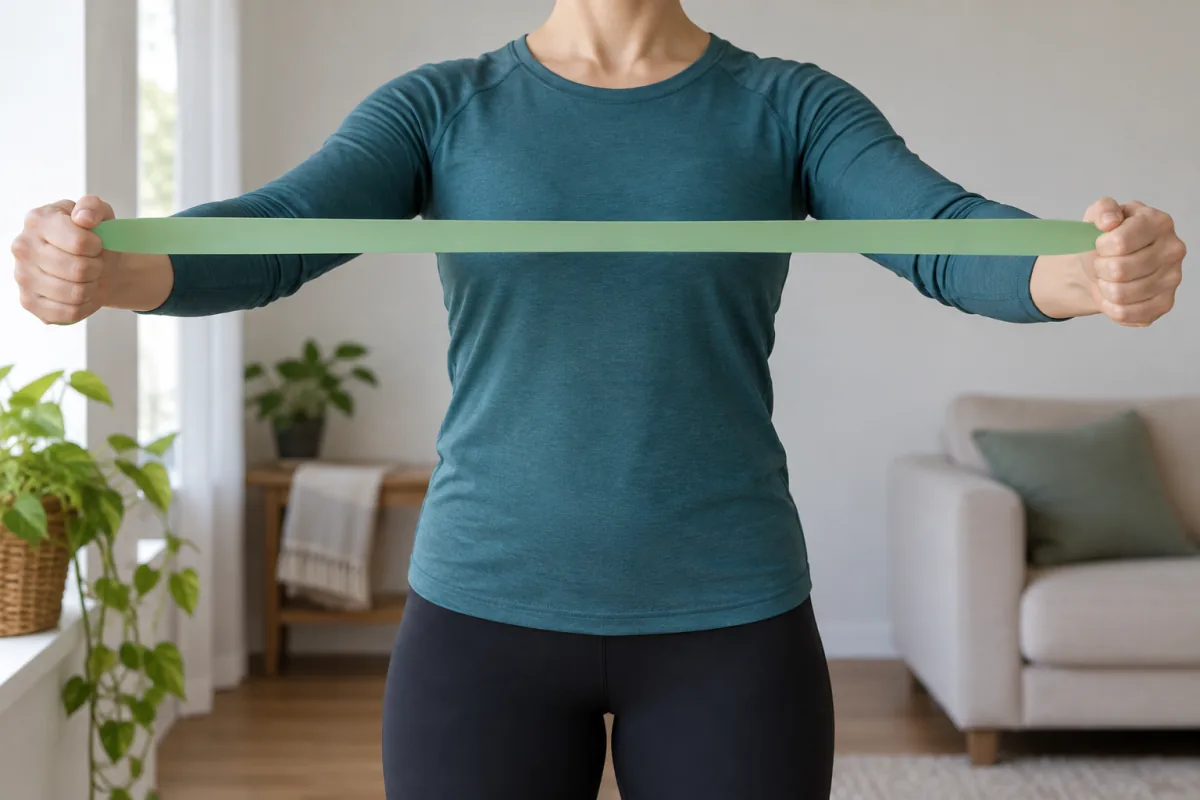
- Band pull-aparts. If you have a resistance band, hold it at shoulder height and pull it apart until it touches your chest. 2 sets of 15. A towel held taut works if you have no band.
Part 3: Mobilise the upper back (2 minutes)
- Thoracic extension over a chair. Sit, hands behind your head, lean back over the top of the chair back so your upper spine arches. 10 slow repetitions.
- Cat-cow. On hands and knees, alternate arching and rounding the spine. 10 slow cycles.
Sets, reps and progression
| Exercise | Weeks 1 to 2 | Weeks 3 to 6 | After 6 weeks |
|---|---|---|---|
| Doorway stretch | 2 x 30 s | 3 x 30 s | 2 x 45 s |
| Chin tucks | 10 | 15 | 15 with light hand resistance |
| Wall angels | 2 x 8 | 2 x 12 | 3 x 12 |
| Scapular squeezes | 2 x 10 | 2 x 15 | Add band rows |
| Prone Y raises | 2 x 8 | 2 x 12 | Add light weights, 0.5 to 1 kg |

Habit changes that do most of the work
Exercise for ten minutes cannot undo eight hours of slumping. These changes matter more than any single move.
- Bring the phone to your face, not your face to the phone. Hold it at chest to chin height. It feels odd for a week and then becomes normal.
- Raise the laptop. Put it on a stand or a stack of books so the top of the screen is at eye level, and use a separate keyboard. This single change removes most of the forward head load for desk workers.
- Set a movement timer. Every 30 to 45 minutes, stand up, roll the shoulders back five times and do three chin tucks. It takes 20 seconds.
- Change your sleeping setup. Side sleepers need a pillow that keeps the neck level with the spine. Stomach sleeping twists the neck for hours and is worth giving up.
- Watch the bag. A heavy bag on one shoulder pulls that side forward. Use a backpack with both straps or switch sides often.
Desk-based work tightens the hips and lower back as well as the shoulders. Our stretches for desk workers pair well with this routine, and a beginner yoga routine covers the upper back mobility side.
What about posture correctors and braces?
A posture brace pulls the shoulders back mechanically. It can be a useful reminder for short periods, 20 to 30 minutes at a time, while you are learning what neutral feels like. Worn for hours, it does the job your muscles should be doing, and they get weaker, not stronger. If you buy one, treat it as a training aid for the first two weeks, not a fix.
Common mistakes
- Forcing the shoulders back all day. Rigidly holding “good posture” fatigues muscles and creates new tension. The aim is a balanced resting position, not a military stance.
- Only stretching. Stretching the chest without strengthening the back gives a few hours of relief and then the shoulders roll forward again.
- Doing the routine twice a week. The muscles need frequent, small signals. Daily for ten minutes beats twice a week for thirty.
- Ignoring the hips. Tight hip flexors tilt the pelvis, which rounds the back, which pulls the shoulders forward. The chain starts lower than you think.
- Pushing through pain. Mild muscle fatigue is fine. Sharp pain, pinching in the shoulder or tingling down the arm is a reason to stop.
When to see a professional
This routine suits adults with posture-related stiffness and no underlying condition. See a doctor or physiotherapist before starting if you have any of these.
- Numbness, tingling or weakness in the arms or hands.
- Neck or shoulder pain that wakes you at night or does not ease with rest.
- A recent injury, a diagnosed disc problem, osteoporosis or inflammatory arthritis.
- Headaches that started with the neck pain and are getting worse.
- Rounding that appeared quickly or is markedly worse on one side.
The Mayo Clinic office stretch guide is a good reference for safe technique, and a physiotherapist can tailor the routine if progress stalls after eight weeks. If you are getting the routine right and still feel constant tightness, poor sleep and fatigue often sit behind it. Our guide on sleeping positions for back pain covers pillow and mattress setup that helps the whole spine.
Frequently asked questions
How long does it take to fix rounded shoulders?
Most people feel looser within two to three weeks and see a visible change in six to eight weeks with daily practice. Long-standing posture can take three to six months to fully settle.
Can rounded shoulders be fixed permanently?
In most cases, yes, as long as the habits that caused them change too. The muscles will drift back to the old pattern if phone and desk habits do not.
Do posture correctors work?
Only as a short-term reminder. Worn for hours they weaken the muscles that should hold you upright.
Is it too late to fix posture at 40 or 50?
No. Muscles respond to training at any age. Progress may be slower and any joint conditions need to be considered, but improvement is realistic.
Should I stop using my phone?
No. Raise it to eye level, take breaks every 30 to 45 minutes and shorten the longest sessions. The position matters far more than the total time.