

For most people with lower back pain or sciatica, the best sleeping position is on your side with a pillow between your knees, or on your back with a pillow under your knees. Both keep the spine in a neutral line and take pressure off the nerve roots that sciatica irritates. Stomach sleeping is the position most likely to make things worse. Which of the two good options suits you depends on where your pain is and what eases it, so this guide gives you a quick way to test, the pillow setups that make each position work, and a short pre-bed routine that helps the position do its job.
- Side sleeping with a pillow between the knees stops the top leg pulling the pelvis and lower spine out of line.
- Back sleeping with a pillow under the knees flattens the lower back curve, which relieves many people with disc-related sciatica.
- If pain eases when you lean forward, try the curled side position; if it eases when you arch back, try back sleeping with a small lumbar roll.
- Mattress matters less than the internet claims; a medium-firm surface suits most backs.
- Sciatica that comes with numbness in the groin, weakness in a leg or changes in bladder or bowel control is an emergency.
Table of Contents
- 1 Why back pain often feels worse at night
- 2 Position 1: on your side with a pillow between your knees
- 3 Position 2: on your back with a pillow under your knees
- 4 The position to avoid: stomach sleeping
- 5 Finding your position: a 30-second test
- 6 Mattress and pillow: what matters
- 7 A ten-minute pre-bed routine
- 8 Common mistakes
- 9 Who this is not for, and when to seek help now
Why back pain often feels worse at night
Lying still for hours lets inflamed tissue stiffen, and some positions load the discs and joints in ways standing never does. Sciatica adds a second problem: the sciatic nerve runs from the lower spine through the buttock and down the back of the leg, and anything that compresses or stretches it, from a bulging disc to a tight piriformis muscle, sends pain along that path. Twisting the pelvis, letting the top knee drop forward, or arching the back with the stomach down all tug on that nerve.
The good news is that most episodes settle. The NHS notes that sciatica usually improves within four to six weeks, and the aim of a good sleeping position is to stop nights from resetting your progress each day.
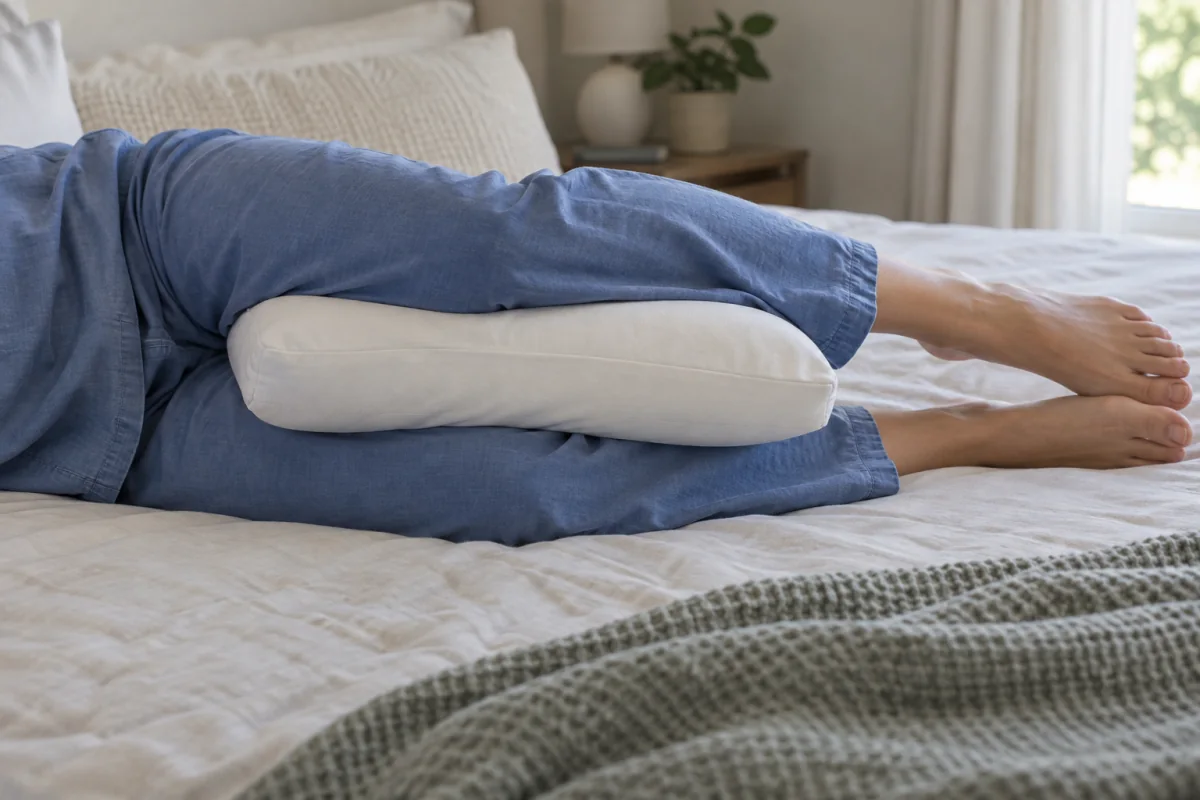
Position 1: on your side with a pillow between your knees
This is the default recommendation because it works for the widest range of back problems.
- Lie on the side that hurts less. Many people with one-sided sciatica find lying on the painful side compresses it, while lying on the other side lets the leg hang and stretch the nerve. Test both.
- Bend both knees slightly. Keep them roughly in line with each other rather than letting the top one slide forward.
- Place a firm pillow between your knees and, ideally, running down between the ankles. A thin one lets the top knee drop; a very thick one tilts the pelvis the other way.
- Fill the gap between your waist and the mattress with a small rolled towel if your hips are wide relative to your waist.
- Use a head pillow high enough to keep your neck level with your spine. On your side that is usually thicker than a back sleeper’s pillow.
A full-length body pillow does the job of the knee pillow and gives your top arm somewhere to rest, which stops you rolling forward onto your stomach during the night.
The curled variation
If your back feels better when you bend forward (sitting, for example), draw your knees up further towards your chest into a loose fetal position. This opens the spaces between the vertebrae where the nerve roots exit, which is why it eases some cases of spinal stenosis. Do not curl so tightly that your neck bends down; keep the head pillow supporting a neutral neck.
Position 2: on your back with a pillow under your knees
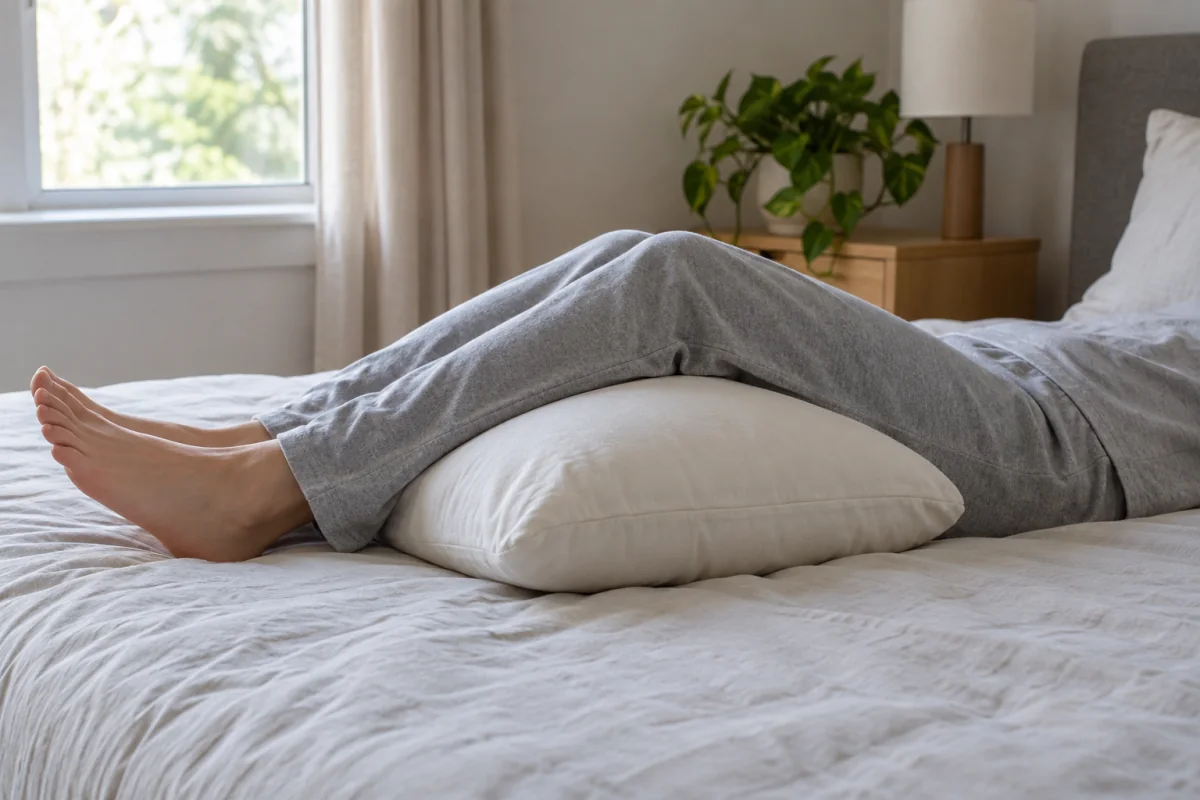
Back sleeping spreads your weight evenly and avoids any twist. The problem is that lying flat lets the lower back arch, and the pillow under the knees fixes that.
- Lie flat with a pillow that supports the curve of your neck without pushing your head forward.
- Place a pillow, folded blanket or bolster under both knees so they are bent 20 to 30 degrees. The lower back should feel like it has settled into the mattress.
- If a gap remains under your lower back, add a small rolled towel there. Do not use a large lumbar roll unless arching backwards is what relieves your pain.
- Keep your arms at your sides or on your stomach, not above your head, which tilts the pelvis.
This position tends to suit people with disc-related sciatica whose pain eases when they lie down and worsens when they bend forward.
The position to avoid: stomach sleeping
Lying face down forces the lower back into an exaggerated arch and the neck into a full twist for hours. For someone with a healthy back it is merely unhelpful; for someone with sciatica or facet joint pain it is a reliable way to wake up worse. If you cannot sleep any other way, place a thin pillow under your hips and lower abdomen to reduce the arch, and use a very flat head pillow or none at all. Better still, train yourself out of it with a body pillow that makes rolling forward awkward.
Finding your position: a 30-second test
Stand up. Gently bend forward as if to touch your toes, then gently arch backwards with hands on your hips. Notice which movement eases the leg or back pain and which sharpens it.
| Pain eases when you | Try first | Setup |
|---|---|---|
| Bend forward | Curled side position | Knees drawn up, pillow between knees |
| Arch backward | Back sleeping | Small pillow under knees, small towel roll under lower back |
| Neither, or both hurt | Neutral side position | Knees slightly bent, firm pillow between knees, body pillow in front |
| Lie on one specific side | That side | As above; note which side and stick with it |
Give a position three or four nights before judging it. The first night in a new setup is often restless for reasons that have nothing to do with the back.
Mattress and pillow: what matters
The evidence on mattresses is thinner than the marketing. The best-known trial found that a medium-firm mattress produced better outcomes for chronic low back pain than a firm one, and most later studies point the same way: medium-firm, supportive enough that your hips do not sink, soft enough that your shoulder can press in when side sleeping. A mattress that sags in the middle should be replaced or, as a stopgap, turned or placed on a board.
A mattress topper of 5 to 8 cm can rescue a too-firm bed cheaply. For pillows, the rule is that the neck should be straight in whichever position you sleep: thicker for side sleepers, thinner for back sleepers. Memory foam or latex holds shape better than feathers for people who need consistent support.
A ten-minute pre-bed routine
A good position holds the gains; movement before bed creates them. This sequence is gentle and suits most backs, but stop any movement that sends pain down the leg.
- Knees-to-chest: lying on your back, draw one knee towards your chest and hold 20 to 30 seconds. Switch. Then both together if that feels fine.
- Pelvic tilts: on your back with knees bent, flatten your lower back into the floor, hold five seconds, release. Ten repetitions.
- Piriformis stretch: on your back, cross one ankle over the opposite knee and gently pull the lower thigh towards you. Hold 30 seconds each side. This targets the buttock muscle that can compress the sciatic nerve.
- Cat-cow: on hands and knees, alternate gently arching and rounding the back for a minute.
- Warmth: a heat pack on the lower back for ten minutes before lying down relaxes the surrounding muscles.
Daytime posture feeds nighttime pain. The stretches for desk workers and the guide to fixing rounded shoulders address the hours that set the back up for a bad night. A gentle morning yoga routine for beginners can help loosen a stiff back at the other end of the night.
Common mistakes
- Using a soft, squashy pillow between the knees. It compresses to nothing and the top leg drops anyway.
- Stacking pillows under the head. A high head pillow bends the neck and shifts the whole spine.
- Sleeping in a recliner for weeks. It can help for a few nights in an acute flare, but it fixes the hips and knees in flexion and leads to stiffness.
- Staying rigidly still. Changing position a few times a night is normal and healthy; the aim is a good default, not immobility.
- Waiting months before getting assessed. Pain that is not improving after six weeks deserves a physiotherapist or doctor.
Who this is not for, and when to seek help now
These positions suit common mechanical back pain and typical sciatica. They are not a substitute for assessment if you have had a fall or injury, if you have osteoporosis, a history of cancer, or if pain wakes you regularly from deep sleep rather than stopping you getting to sleep. The Mayo Clinic’s sciatica guidance lists the signs that need urgent care: sudden severe pain with leg weakness, numbness in the inner thighs or around the groin, or any loss of bladder or bowel control. Those can indicate cauda equina syndrome, which needs emergency treatment the same day. Pregnant women with back pain should sleep on the left side with a pillow between the knees and discuss persistent pain with their midwife.
Frequently asked questions
Should I sleep on the side with sciatica or the other side?
Usually the side that does not hurt, so the affected leg rests on top, supported by a pillow between the knees. Some people find the opposite; test both for two nights each.
Is a firm mattress better for lower back pain?
Medium-firm has the best evidence. A very firm mattress pushes on the hips and shoulders and leaves the lower back unsupported.
Why is my sciatica worse in bed?
Lying still lets inflamed tissue stiffen, and positions that twist the pelvis or arch the back stretch or compress the nerve. Getting the position and pillows right usually helps within a few nights.
Can a pillow between the knees really make a difference?
Yes. Without it, the top leg falls forward, rotating the pelvis and lower spine for hours. A firm pillow keeps the hips stacked and is one of the simplest changes with a noticeable effect.
How long until a new sleeping position helps?
Many people notice less morning stiffness within a week. Sciatica itself typically improves over four to six weeks; the sleeping position supports that recovery rather than replacing treatment.