
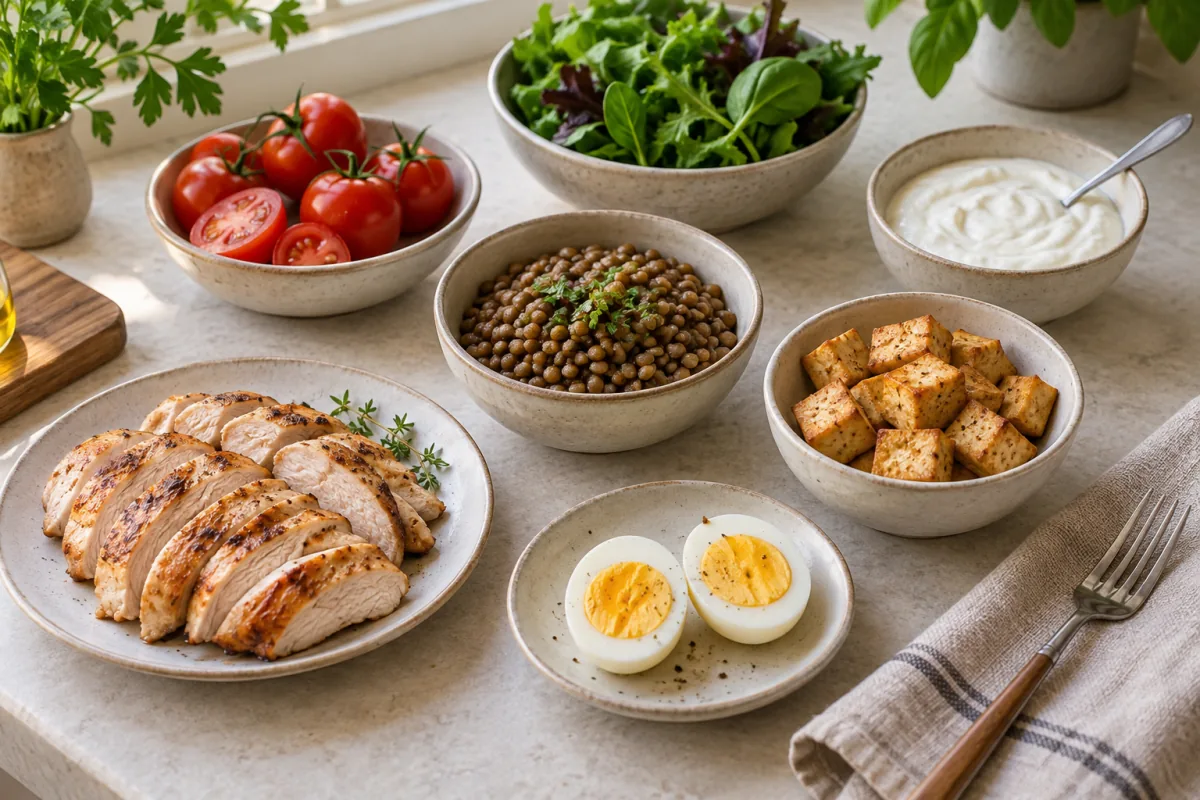
How much protein per day do you need? For most adults the answer is somewhere between 0.8 and 2.2 grams per kilogram of body weight. Where you land in that range depends on what you are trying to do. Sitting still and staying healthy needs the low end. Losing fat without losing muscle, or building muscle in the gym, needs the high end. A 70 kg person, for example, needs around 56 g a day to meet the basic requirement and around 110 to 150 g a day if they train hard and want to change their body. The rest of this article shows you how to pick your own number, what that looks like on a plate, and the mistakes that make people miss their target even when they think they are hitting it.
Table of Contents
Key takeaways
- Maintenance: 0.8 g per kg of body weight per day. Fat loss while keeping muscle: 1.6 to 2.2 g per kg. Muscle gain: 1.6 to 2.0 g per kg.
- Use your current weight for the calculation unless you are well above a healthy weight, in which case use your goal weight.
- Spread protein over three or four meals of 25 to 40 g each. One giant dinner is less useful than the same amount split up.
- Protein does not cancel calories. Too much of it, or of anything else, still adds up.
- If you have kidney disease, are pregnant, or take medication for a long-term condition, ask your doctor before pushing intake above the basic requirement.
The short answer: grams per kilogram by goal
Protein targets are set per kilogram of body weight because a 50 kg person and a 100 kg person do not need the same amount. Multiply your weight in kilograms by the figure that matches your goal. If you think in pounds, divide by 2.2 first.
| Goal | Grams per kg per day | 70 kg person | 90 kg person |
|---|---|---|---|
| General health, little exercise | 0.8 to 1.0 | 56 to 70 g | 72 to 90 g |
| Active, wants to stay lean | 1.2 to 1.6 | 84 to 112 g | 108 to 144 g |
| Fat loss on a calorie deficit | 1.6 to 2.2 | 112 to 154 g | 144 to 198 g |
| Muscle gain with resistance training | 1.6 to 2.0 | 112 to 140 g | 144 to 180 g |
| Adults over 65 | 1.0 to 1.2 | 70 to 84 g | 90 to 108 g |
A worked example. Priya weighs 64 kg, lifts weights three times a week and wants to lose a few kilograms of fat without losing the strength she has built. She sits in the fat-loss row. 64 multiplied by 1.6 is 102 g, and 64 multiplied by 2.2 is 141 g. She picks 120 g as a daily target because it is in the middle and easy to remember. That is her number.
One adjustment: if you carry a lot of extra weight, calculating from your current weight can give a number that is hard to eat. Use your goal weight instead, or a weight you were at when you last felt comfortable. A 120 kg person aiming for 95 kg would calculate from 95 kg.
Why the RDA and the fitness number are so different
The Recommended Dietary Allowance of 0.8 g per kg was set as the amount that prevents deficiency in nearly all healthy adults. It is a floor, not an optimum. It was never designed for someone trying to hold on to muscle while eating less, or trying to add muscle while lifting weights.
Research on active people points higher. The International Society of Sports Nutrition position stand recommends 1.4 to 2.0 g per kg for people who exercise regularly. A 2018 meta-analysis of 49 trials found that the benefit of extra protein for muscle gain levelled off at around 1.6 g per kg per day, with little added from going higher. That is why 1.6 shows up so often as the practical target: it captures nearly all of the benefit, and anything above it is insurance rather than progress.
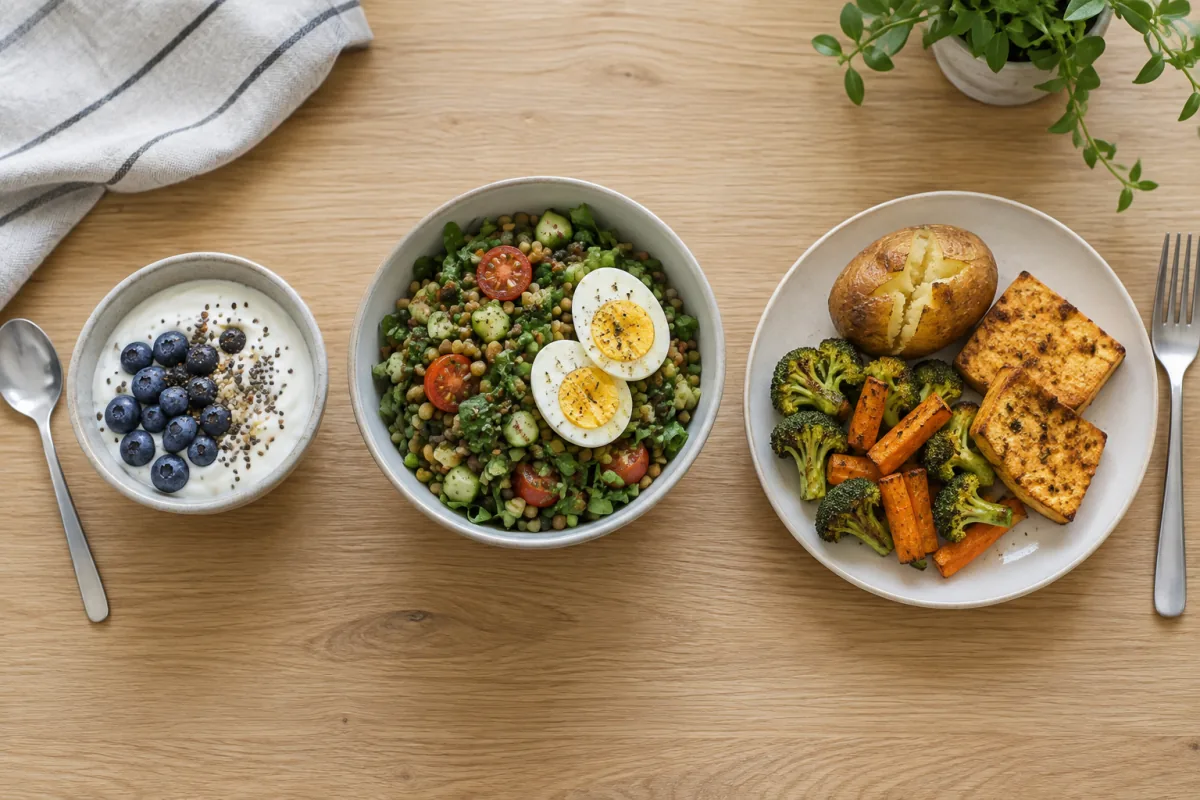
How to hit your number: two sample days
Targets only matter if they turn into meals. Here is what 120 g of protein looks like at two different calorie levels. The lower day suits a smaller person on a deficit. The higher day suits a larger person or someone training hard.
Around 1,600 calories, roughly 120 g protein
- Breakfast: 200 g plain Greek yoghurt with berries and a tablespoon of seeds. About 20 g protein.
- Lunch: two eggs plus 100 g cooked lentils in a salad with olive oil. About 24 g.
- Snack: 150 g cottage cheese or 40 g roasted chickpeas. About 15 g.
- Dinner: 150 g chicken breast or firm tofu, 150 g roasted vegetables, a small potato. About 40 g.
- Evening: a glass of milk or a soy milk. About 8 g.
Around 2,400 calories, roughly 160 g protein
- Breakfast: three-egg omelette with spinach, two slices of wholegrain toast. About 28 g.
- Mid-morning: 200 g Greek yoghurt, a banana, a handful of almonds. About 24 g.
- Lunch: 150 g tinned tuna or paneer with 200 g cooked rice and vegetables. About 40 g.
- Snack: cheese and an apple, or a bowl of edamame. About 14 g.
- Dinner: 180 g lean mince or tempeh in a stir-fry with noodles. About 45 g.
- Evening: milk or a small bowl of dal. About 9 g.
Notice that neither day depends on a shake. Powder is convenient, not necessary. If a meal is falling short, the simplest fixes are to add an egg, swap white rice for a rice-and-lentil mix, add a spoon of yoghurt, or make the meat or tofu portion a little bigger.
If your evenings are the weak point, our list of high-protein snacks under 200 calories fills the gap without blowing the calorie budget.
Spread it out or eat it all at once?
Muscle building is switched on by each protein-containing meal and then switches off again after a few hours. For that reason, spreading intake over three to five meals works better than one large hit. A useful rule is 0.4 g per kg per meal, which is 25 to 30 g for most women and 30 to 40 g for most men.
This matters most for people who skip breakfast, eat a small lunch and then have a huge dinner. The total might be fine, but two of the three chances to build or keep muscle were wasted. Moving even 20 g from dinner to breakfast is an easy improvement.
Timing right after a workout is less important than the fitness world once claimed. The window is more like several hours than thirty minutes. If you ate a protein-containing meal within two or three hours before training, you have time. If you trained fasted, eat a normal meal within an hour or two.
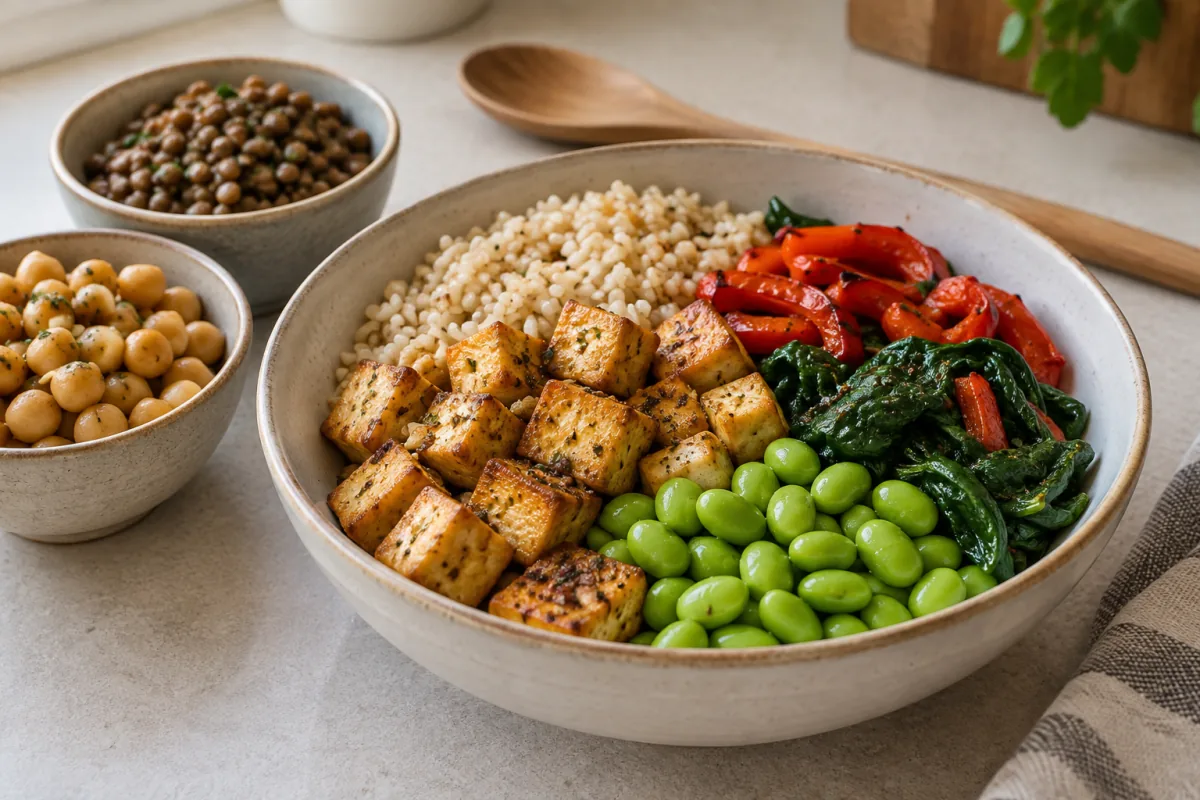
Plant-based protein: what changes
Plant proteins work. They are slightly less digestible than animal proteins and some are lower in the amino acid leucine, which acts as the main switch for muscle building. Two adjustments cover this.
- Aim for the top of your range rather than the bottom. If your goal says 1.6 to 2.2 g per kg, aim for 1.8 or higher.
- Mix sources across the day. Lentils with rice, beans with wholegrain bread, hummus with pitta, tofu with edamame. You do not need to combine them in the same meal, just across the day.
The NHS Eatwell Guide shows how the food groups fit together. The richest plant sources per serving are tofu and tempeh, seitan, lentils, chickpeas, black beans, edamame, soy milk, and quinoa. Nuts and seeds help but come with a lot of calories per gram of protein, so treat them as a top-up rather than a main source.
Common mistakes
Counting the same protein twice
People log “chicken salad, 40 g” and then log the chicken again. Or they log a protein bar and the shake they had with it as two meals when the bar was mostly sugar. Weigh the actual protein food raw or cooked (either works, just be consistent) and use one source of nutrition data for the week.
Ignoring calories
Protein is filling and it costs the body a little more energy to digest, but it is not free. A 2,400 calorie diet with 200 g of protein is still 2,400 calories. If the scale is not moving, the answer is rarely “more protein”. If you are stuck, read why you are not losing weight in a calorie deficit before changing anything else.
Chasing 2 g per kg without training
High intakes make sense when you are giving muscle a reason to grow or a reason to stay. If you are not lifting, walking uphill or otherwise loading your muscles, 1.0 to 1.2 g per kg is plenty. Extra protein without a stimulus is just extra food. If you are new to exercise, start with how to start working out and let the diet follow.
Who should ask a doctor first
For healthy adults, intakes up to about 2 g per kg per day have been studied for years and show no harm to kidney function. That does not apply to everyone.
- Kidney disease or reduced kidney function. The kidneys clear the waste products of protein breakdown. If they are already under strain, a higher intake can add to the load. Your kidney specialist or GP will set a limit for you, and it may be lower than the RDA.
- Pregnancy and breastfeeding. Requirements go up, but the right amount and the right sources (some fish and soft cheeses are restricted) depend on your situation. Ask your midwife or doctor rather than following gym advice.
- Liver disease, gout, or a history of kidney stones. Each can change what is safe.
Mayo Clinic has a plain-language summary of the signs you are eating more protein than you need. Anything on this site is general information, not personal advice, and a doctor who knows your history is the person to confirm your target.
Frequently asked questions
Can I eat too much protein?
Yes, but for healthy adults the problem is usually crowding out, not poisoning. If protein takes up so much of your calorie budget that fruit, vegetables, whole grains and healthy fats disappear, your diet gets worse even though the protein number looks good. Above around 2.2 g per kg there is no extra benefit for muscle, so there is no reason to go higher.
Do I need protein powder?
No. Powder is a convenient, cheap way to add 20 to 25 g when a meal is short or you are travelling. Whole foods bring fibre, iron, calcium and other nutrients that powder does not. If you use it, treat it as a supplement to meals, not a replacement for them, and check the sugar and additive content on the label.
Is protein timing after a workout important?
Less than most people think. Total daily intake and spreading it across meals matter far more. Eating a normal protein-containing meal within a couple of hours either side of training covers it.
How much protein do older adults need?
More than younger adults, not less. Muscle becomes less responsive to protein with age, so expert groups recommend 1.0 to 1.2 g per kg per day for healthy people over 65, and more for those recovering from illness or doing resistance training. Because appetite often falls with age, spreading protein across every meal, including breakfast, is especially important. Anyone with kidney disease should follow their doctor’s limit instead.