
The military sleep method is a relaxation sequence: you relax your face, drop your shoulders and arms, breathe out, let your legs go heavy, then hold a calm image in your mind for ten seconds. It reportedly came from a 1981 book on performance training that claimed pilots fell asleep within two minutes after six weeks of practice. There are no published trials of the method itself, but every step is borrowed from techniques that do have evidence, mainly progressive muscle relaxation and guided imagery. Used consistently it helps many people fall asleep faster; used once, and judged after five minutes, it usually fails. Here is how to do it properly and what to combine it with.
- The method is progressive muscle relaxation plus a mental image, done in a fixed order. It takes about two minutes to run through.
- The “two minutes” claim comes with a six-week practice period attached. Expect it to take a couple of weeks to become reliable.
- It works best for people whose problem is a busy mind or physical tension at lights-out, not for people with sleep apnoea, chronic insomnia or badly timed schedules.
- If you are not asleep after about 20 minutes, get up briefly. Lying there trying harder trains the bed to mean wakefulness.
- Persistent trouble falling or staying asleep for more than a month is worth raising with a doctor.
Table of Contents
Where the method comes from
The technique appeared in Lloyd Bud Winter’s 1981 book “Relax and Win”, which described a routine used to help trainee pilots sleep under stressful conditions. The book’s claim was that 96 percent of pilots could fall asleep within two minutes after six weeks of daily practice. That number has never been independently verified, and the original programme included far more than the bedtime sequence. What survives online is the sequence itself, stripped of the training context, which is why so many people try it once and decide it is a myth.
The building blocks are not a myth. Progressive muscle relaxation has been studied since the 1930s and is a standard component of cognitive behavioural therapy for insomnia. The National Center for Complementary and Integrative Health lists it among the relaxation techniques with evidence for helping sleep and reducing anxiety. Guided imagery, the “calm picture” step, has similar support as part of a wind-down routine.
The method, step by step
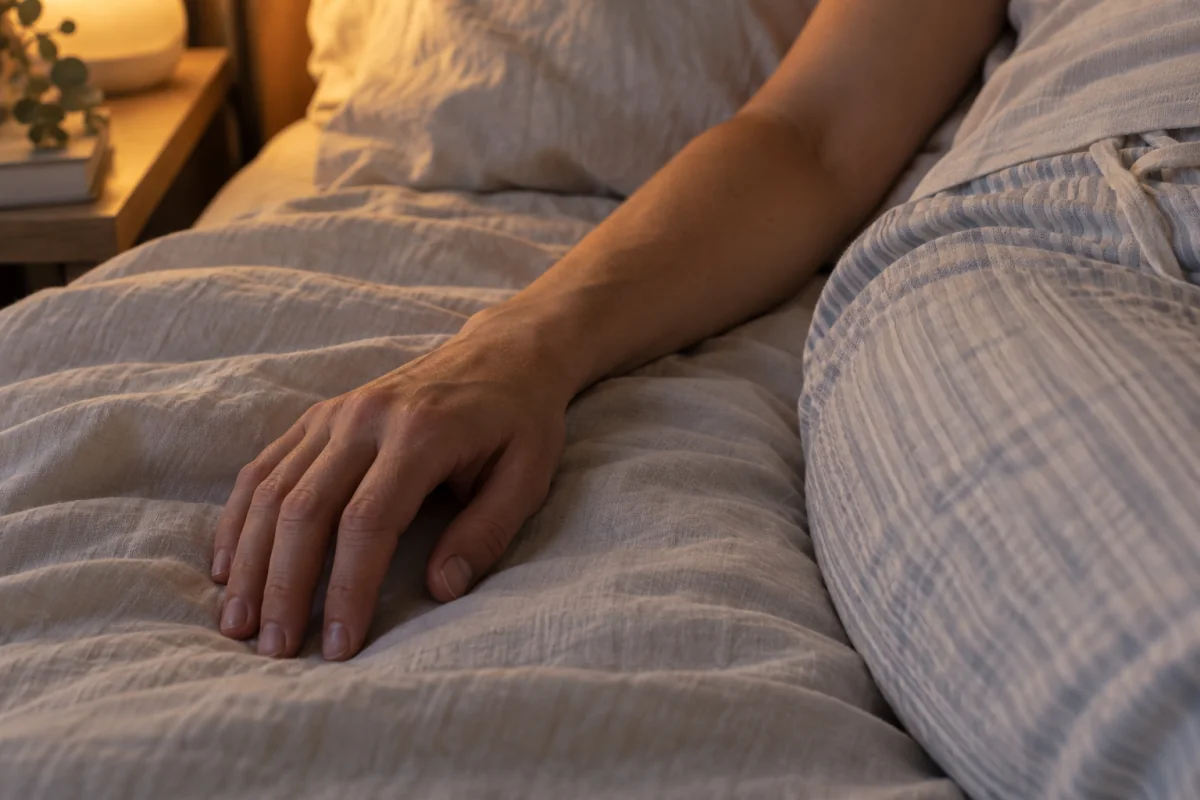
Lie on your back or in your normal sleeping position. Each step takes 10 to 20 seconds. The whole thing runs two minutes, then you hold the image for as long as it takes.
- Face. Close your eyes. Relax your forehead, then your eyelids, then your jaw. Let your tongue rest and your mouth fall slightly open. Most people carry more tension in the jaw and around the eyes than they realise.
- Shoulders. Let them drop as far from your ears as they will go. Feel the weight of them sinking into the mattress.
- Arms. Relax one upper arm, then the forearm, then the hand and fingers. Repeat on the other side. Imagine them too heavy to lift.
- Breath. Take one slow breath in, and a longer breath out. As you exhale, let your chest soften.
- Legs. Relax your right thigh, then calf, ankle and foot. Then the left. Same heavy feeling.
- Mind. For ten seconds, hold one of two images: lying in a canoe on a still lake under a clear sky, or lying in a black velvet hammock in a completely dark room. If thoughts intrude, repeat “don’t think” slowly to yourself for ten seconds, then return to the image.
The order matters less than the completeness. Skipping straight to the image without releasing the body is the most common reason it does not work.
Making each step count
- Tense before you relax. Squeezing a muscle group for five seconds and then letting go produces a much stronger sense of release than trying to relax from neutral. This is the core of progressive muscle relaxation.
- Exhale longer than you inhale. A four-count in and a six- to eight-count out nudges the nervous system towards rest.
- Pick one image and keep it. Switching between images each night gives the mind something to do, which is the opposite of the point.
- Do it in the dark with the phone in another room. The method cannot compete with a screen.

Why it works when it works
Falling asleep requires two things: enough sleep pressure (you have been awake long enough) and a nervous system that has shifted out of alert mode. The military method does nothing about the first and quite a lot about the second. Releasing muscle tension lowers the signals of arousal the body sends to the brain. Slow exhalation lowers heart rate. A fixed, boring image occupies the part of the mind that would otherwise replay the day or rehearse tomorrow.
That is also why it fails for some people. If you went to bed at 9 p.m. after a lie-in, no relaxation routine will generate sleep pressure that is not there. If your bedroom is warm and bright, or you drank coffee at 5 p.m., the method is fighting uphill. And if the racing thoughts are about something real and unresolved, a canoe image may hold them off for ten seconds and no longer. For that pattern, the tools in how to stop overthinking at night address the thoughts themselves.
Set the conditions first
The method is the last step in a chain. Get the earlier links right and it has far less work to do.
| Condition | Target | Why |
|---|---|---|
| Wake time | Same every day, weekends included | Anchors the body clock so sleep pressure builds on schedule |
| Caffeine | None after early afternoon | Half-life of five to six hours |
| Light | Dim for the last hour; dark bedroom | Light suppresses melatonin |
| Temperature | Cool room, warm feet | Core temperature needs to drop to initiate sleep |
| Screens | Out of the bedroom | Both the light and the content keep the mind alert |
| Alcohol | Avoid within three hours of bed | Speeds sleep onset but fragments the second half of the night |
| Food | Light evening meal, two to three hours before bed | Digestion and reflux interfere with sleep onset |
The Mayo Clinic’s sleep tips cover the same fundamentals. What you eat in the evening matters more than most people expect; the specifics are in foods that help you sleep better at night.
The six-week practice plan
Since the original claim depended on practice, treat it like one.
- Weeks 1 and 2: do the full sequence every night, and once during the day sitting in a chair. Daytime practice teaches the body the pattern without the pressure of needing to sleep.
- Weeks 3 and 4: add the tense-and-release version for the face, shoulders and legs. Notice which areas hold the most tension.
- Weeks 5 and 6: shorten the sequence. By now a single long exhale and the image should trigger the same release in under a minute.
- Throughout: if you are not asleep after roughly 20 minutes, get up, sit in dim light, do something dull, and return when sleepy. This is the single most effective rule in insomnia treatment and it protects the method from becoming a source of frustration.
Pair the sequence with a two-minute breathing exercise before you lie down. The options in five-minute breathing exercises lead naturally into it.
Common mistakes
- Trying to fall asleep. The method relaxes; sleep follows on its own. Monitoring whether it is working yet keeps you awake.
- Checking the time. Every glance resets alertness. Turn the clock away.
- Doing it with tension still in the jaw and shoulders. Go back and release them properly.
- Quitting after three nights. The evidence-based components take one to two weeks to feel natural.
- Using it to override a bad schedule. If you wake at 6 a.m. on weekdays and 11 a.m. on Sundays, Sunday night will be hard regardless.
Who this is not for
The method is a good fit for occasional difficulty switching off and for people who lie awake tense after a stressful day. It is not a treatment for chronic insomnia, which the NHS defines as trouble sleeping several nights a week for three months or more; that responds best to cognitive behavioural therapy for insomnia, which a doctor can refer you to. It will not help sleep apnoea, restless legs, or pain that wakes you, all of which need a medical assessment. And if you regularly fall asleep within minutes but wake at 3 a.m., the problem is sleep maintenance, not onset, and the causes in why do I wake up at 3 a.m. are the better starting point.
Frequently asked questions
Does the military sleep method really work in two minutes?
For some people after weeks of practice, yes. For a first attempt, no. The sequence itself takes about two minutes; falling asleep afterwards depends on practice, sleep pressure and the bedroom conditions.
Is there scientific evidence for the military sleep method?
Not for the method as a package. Its components, progressive muscle relaxation, slow breathing and guided imagery, have decades of research supporting their use for sleep and anxiety.
Can I use it if I have insomnia?
You can, and it is often part of a wider programme. But chronic insomnia usually needs cognitive behavioural therapy for insomnia rather than a relaxation technique alone. Ask your doctor.
What if my mind will not stop during the image step?
Repeat “don’t think” slowly for ten seconds, then return to the image. If a specific worry keeps returning, write it down before bed so the mind can let it go.
Is it safe to use every night?
Yes. It is a relaxation exercise with no side effects. If anything, nightly use is what makes it effective.