
After one month of 16:8 intermittent fasting, most people who stick with it see a modest drop on the scale, usually in the range of 1 to 4 kg, along with less evening snacking, steadier energy in the afternoon and, for some, better sleep. The results depend far more on what you eat inside the eight-hour window than on the fasting itself. This guide sets out what changes week by week, what the research actually supports, who should not try it, and how to run a first month that gives you a fair test.
Table of Contents
- 1 Key takeaways
- 2 What 16:8 actually is
- 3 What the research says about one month
- 4 Week-by-week: what to expect
- 5 What a realistic month can look like
- 6 How to set up a first month that gives a fair test
- 7 Common mistakes that cancel the results
- 8 Who should not do 16:8
- 9 Should you continue after month one?
Key takeaways
- 16:8 means eating within an 8-hour window and fasting for 16, including sleep. Water, black coffee and plain tea are fine during the fast.
- Typical one-month weight change is 1 to 4 kg, mostly from eating fewer calories, not from fasting magic.
- The first 5 to 10 days are the hardest. Hunger usually settles by week two.
- Research shows 16:8 works about as well as ordinary calorie reduction, not better.
- It is not suitable for people with diabetes on medication, a history of eating disorders, pregnancy or breastfeeding without a doctor’s approval.
What 16:8 actually is
16:8 is a form of time-restricted eating. You choose an eight-hour window, for example 11am to 7pm or 12pm to 8pm, and eat your meals inside it. Outside the window you take only water, black coffee, plain tea or other zero-calorie drinks. There are no rules about which foods to eat, which is both its appeal and its main weakness.
Because eight hours is a short time to fit three meals, most people naturally drop one, usually breakfast. That alone often removes 300 to 500 calories a day, which is why the scale moves. The National Institute on Aging summarises the human evidence as promising but early, with most benefits tied to eating less overall.
What the research says about one month
Short trials of time-restricted eating lasting four to twelve weeks generally find the following.
- Weight loss of roughly 1 to 4 percent of body weight, similar to what people achieve with a standard calorie-controlled diet over the same period.
- Small improvements in fasting blood sugar and blood pressure in some participants, mostly those who were overweight to begin with.
- No consistent advantage over simply eating less, when calories are matched.
- Dropout rates similar to other diets. The people who succeed are the ones who find the window easy to keep.
The honest summary: 16:8 is a scheduling tool that makes it easier for some people to eat less. If the window helps you do that without misery, it works. If you eat the same amount in eight hours as you did in fourteen, nothing changes. The NIDDK weight management pages are a good plain-language overview of what drives weight change in the first place.

Week-by-week: what to expect
Week 1: hunger, irritability, and water loss
Expect real hunger around your old breakfast time, a headache or two, and a shorter fuse. Some of this is habit, some is caffeine timing, and some is your body adjusting. The scale often drops 1 to 2 kg quickly. That is mostly water and glycogen, not fat. Do not read too much into it either way.
Week 2: hunger settles, energy evens out
Ghrelin, the hunger hormone, tends to follow your usual meal times and re-learns the new schedule within about 10 days. Morning hunger fades. Many people notice the mid-afternoon slump gets lighter, probably because they are no longer eating a large lunch on top of breakfast.
Week 3: the real test
The novelty has gone. This is when people discover whether the window fits their life. Social meals, late work dinners and weekends push against it. Weight loss slows to a steadier 0.25 to 0.75 kg per week if you are in a genuine calorie deficit.
Week 4: assessment time
By day 30 you have enough data. Look at your average weight across the last week compared with your first week, not any single day. Look at how your clothes fit. Look at whether you feel deprived or fine. Then decide whether to keep going, adjust the window or stop.
What a realistic month can look like
These are rough expectations, not study results. They assume a genuine calorie deficit, which works out at roughly 0.25 to 1 kg a week, and individual results vary widely.
| Measure | Rough expectation after one month | What drives it |
|---|---|---|
| Body weight | 1 to 4 kg lower | Calorie reduction from skipped meal and less snacking |
| Waist | 1 to 3 cm smaller | Same as above, plus less bloating from late eating |
| Morning hunger | Much lower by week 2 | Ghrelin adapts to new meal timing |
| Evening snacking | Usually stops | Window closes before the snacking hour |
| Sleep | Often better | No large late meals, earlier digestion |
| Gym performance | May dip in week 1, then recovers | Training fasted takes adjustment |
These are ranges seen in trials and in common experience, not promises. Starting weight, activity and what you eat matter more than the clock.
How to set up a first month that gives a fair test
- Pick a window you can keep on a Saturday. If your social life happens at 8pm, a 10am to 6pm window will fail in week three. 12pm to 8pm suits most people with evening commitments.
- Keep the window fixed. Shifting it daily confuses hunger signals and makes the adjustment take longer.
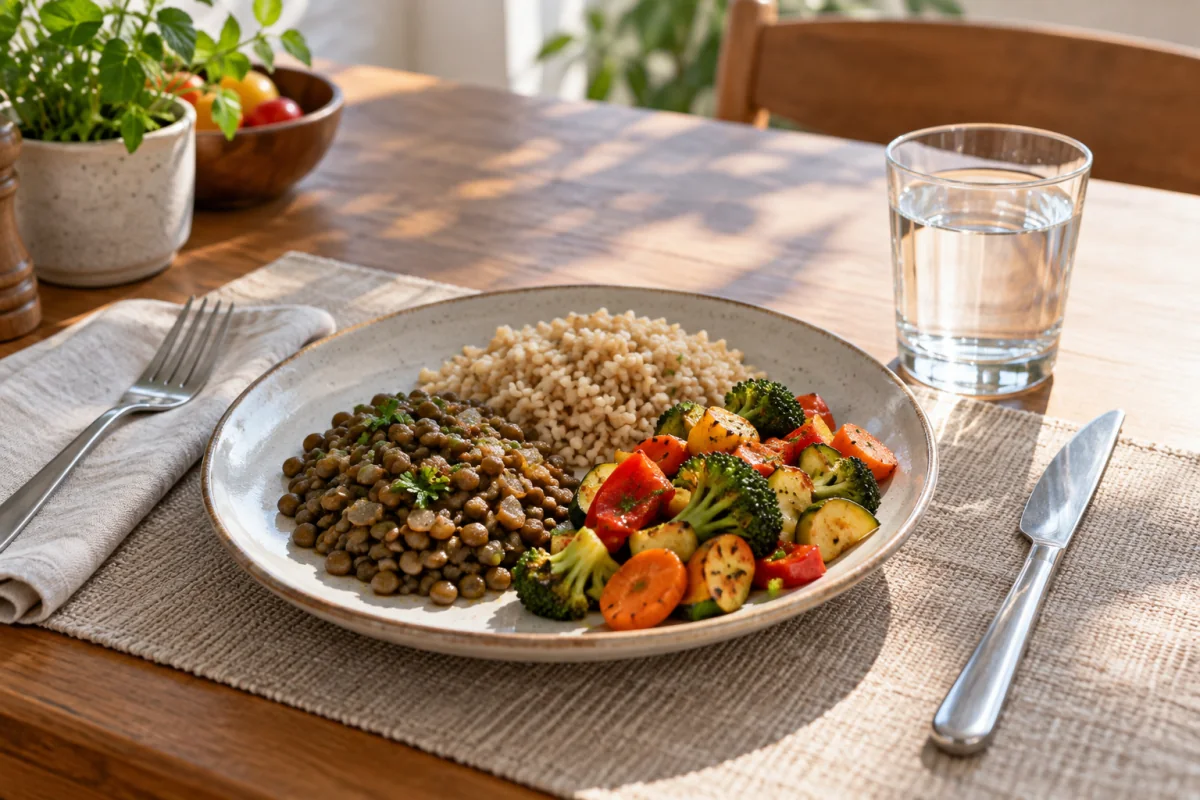
- Eat two proper meals and one snack. Each meal should have a palm-sized portion of protein, a fist of vegetables, a cupped hand of carbohydrate and a thumb of fat. This is not a prescription, it is a way to avoid the common trap of one enormous meal.
- Protein first. Adequate protein is the difference between losing fat and losing muscle. Eggs, dal, paneer, fish, chicken, tofu, Greek yoghurt. Our list of high-protein snacks under 200 calories is useful for the snack slot.
- Drink water through the fast. Thirst is often read as hunger in the first week. Our guide on how much water to drink gives a starting point.
- Weigh yourself daily and average weekly. Daily weight swings 1 to 2 kg on water alone. The weekly average is the signal.
- Move. Fasting does not replace activity. A daily walk keeps the deficit honest and improves mood. See what a month of 30-minute walks does.

Common mistakes that cancel the results
- The “I fasted, so I earned it” meal. A 16-hour fast followed by a 1,500-calorie lunch and a large dinner is not a deficit. It is the same day’s calories compressed.
- Milky coffee during the fast. A latte has 150 to 250 calories and breaks the fast. Black coffee or plain tea only.
- Under-eating protein. Fewer meals makes it easy to fall short. Losing muscle makes the next month harder.
- Treating weekends as off-days. Two days of unrestricted eating can wipe out five days of deficit.
- Cutting the window further to speed things up. Going to 18:6 or 20:4 in week two usually leads to a binge in week three. Master 16:8 first.
- Ignoring sleep. Short sleep raises hunger hormones and makes the fast miserable. If you are not sleeping, fix that first. Our guide to why you are not losing weight in a calorie deficit covers the other hidden reasons.
Who should not do 16:8
Time-restricted eating is not harmless for everyone. Talk to a doctor before starting, or avoid it entirely, if any of these apply.
- You have type 1 diabetes, or type 2 diabetes treated with insulin or sulfonylureas. Fasting can cause dangerous low blood sugar.
- You are pregnant, trying to conceive or breastfeeding.
- You have a history of anorexia, bulimia or binge eating. Rules about when you are allowed to eat can re-trigger these patterns.
- You are under 18 or over 70, or underweight.
- You take medication that must be taken with food at set times.
- You do physically demanding work or heavy training in the morning and cannot fuel it.
The NHS Better Health weight loss guidance focuses on sustainable calorie reduction and activity, and is a sensible fallback if fasting does not suit you.
Should you continue after month one?
Ask three questions. Did your weekly average weight fall? Do you feel fine, not deprived? Can you see yourself doing this in six months? Three yeses mean continue. One or two mean adjust, perhaps a slightly longer window or a different start time. Three noes mean stop and try a different approach. There is nothing special about fasting. The goal is a way of eating you can keep, and that looks different for different people.
Frequently asked questions
How much weight can you lose in a month with 16:8?
Most people lose 1 to 4 kg in the first month, with a chunk of the early loss being water. Results depend mainly on total calories eaten inside the window.
Does coffee break a fast?
Black coffee and plain tea do not. Milk, sugar, cream or syrups add calories and end the fast.
Is it better to skip breakfast or dinner?
Neither is better for weight loss. Pick the one that fits your life. Some evidence favours an earlier window for blood sugar, but the best window is the one you keep.
Can I exercise while fasting?
Light and moderate exercise is fine for most healthy adults. Heavy training on an empty stomach takes adjustment and may reduce performance in the first week or two.
Why has my weight loss stalled after two weeks?
The early water loss has ended and you may be eating more inside the window than you think. Track a few days of intake honestly, check protein, and look at weekend eating.
Is 16:8 safe long term?
For healthy adults, current evidence suggests it is as safe as other calorie-controlled approaches. Long-term data are still limited. Anyone with a medical condition should check with a doctor first.