

A couch to 5K plan takes you from no running at all to 30 minutes of continuous running in nine weeks, three sessions a week, by alternating short runs with walking breaks that shrink as the weeks go on. Week 1 is 60 seconds of jogging followed by 90 seconds of walking, repeated eight times. Week 9 is a 30-minute run. The full schedule is below, along with how slow you should go (slower than you think), what to buy before you start (less than you think), and what to do about shin pain, side stitches and missed weeks, which are the three things that end most people’s attempts.
Table of Contents
Key takeaways
- Three sessions a week, about 30 minutes each including a five-minute walk at each end. Never two days in a row in the first month.
- Run slowly enough to talk. If you cannot say a sentence, you are running too fast for this plan.
- Any comfortable trainers will do for week 1. Buy running shoes once you reach week 4 and know you will continue.
- Repeat any week that felt too hard. The plan is nine weeks for some people and fourteen for others, and both finish.
- Sharp pain that changes how you walk means stop and see a doctor. Dull muscle ache that fades in a day is normal.
Before week 1: shoes, warm-up, where to run
Shoes
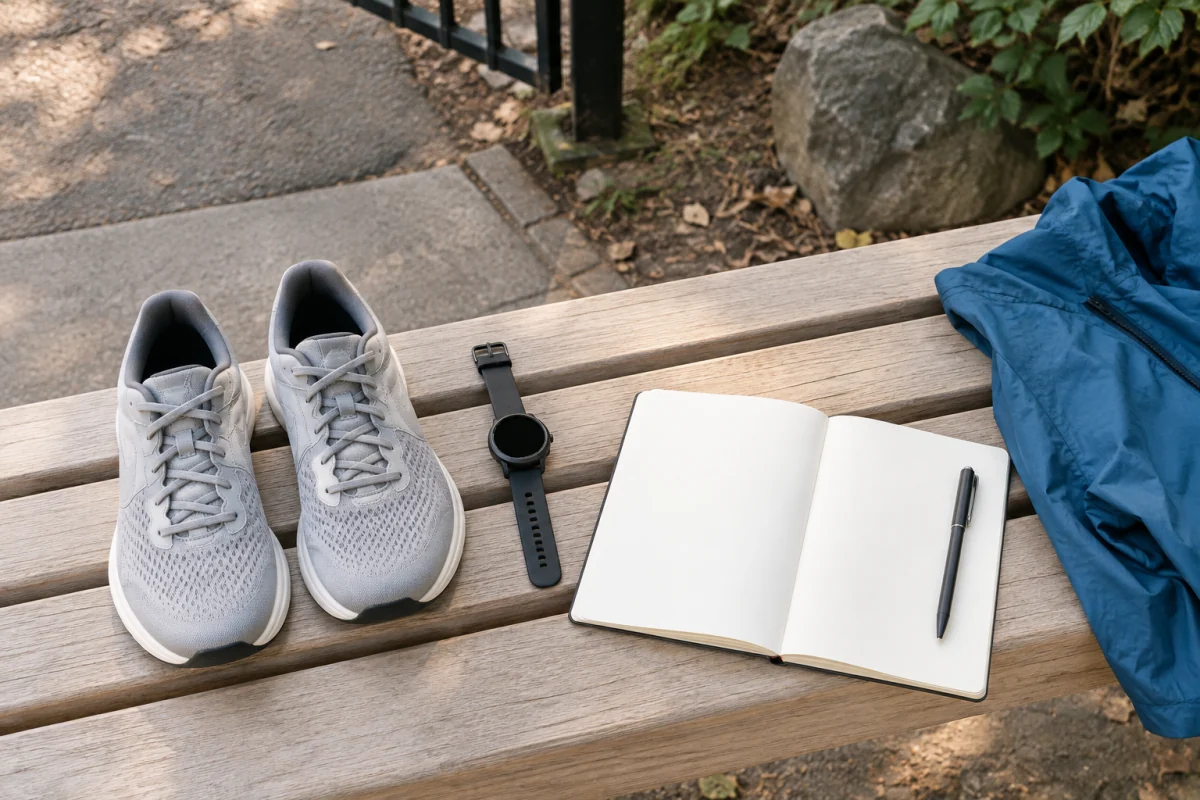
You do not need specialist shoes to jog for 60 seconds at a time. Trainers with a bit of cushioning and no worn-down heel are enough for the first three weeks. If you reach week 4 and are enjoying it, go to a running shop where someone watches you walk and jog, and buy the pair that feels most comfortable on the day. Comfort predicts injury risk better than any technology in the sole.
Warm-up
Every session starts with a five-minute brisk walk. That is the warm-up. Do not stretch cold muscles before running; save stretching for afterwards. If your calves or hips feel stiff, add a minute of walking lunges and leg swings after the walk.
Where
Flat, soft-ish ground is kindest in the early weeks: a park path, a playing field edge, a canal towpath, or a treadmill. Pavement is fine but hills are not, yet. Pick a loop you can repeat so you are not making route decisions while out of breath.
Water and food
Eat something small one to two hours before, and drink normally through the day rather than gulping a bottle at the start. For a 30-minute session you do not need to carry water unless it is hot. If you are unsure how much to drink overall, see how much water to drink for a simple weight-based guide.
The 9-week schedule
Each session begins and ends with a five-minute walk, not shown in the table. Do the same session three times in a week before moving on. The total time column is the middle part only.
| Week | Session (repeat three times that week) | Running total | Session length |
|---|---|---|---|
| 1 | Run 60 seconds, walk 90 seconds. Repeat 8 times. | 8 minutes | 20 minutes |
| 2 | Run 90 seconds, walk 2 minutes. Repeat 6 times. | 9 minutes | 21 minutes |
| 3 | Run 90 seconds, walk 90 seconds, run 3 minutes, walk 3 minutes. Repeat twice. | 9 minutes | 18 minutes |
| 4 | Run 3 minutes, walk 90 seconds, run 5 minutes, walk 2.5 minutes, run 3 minutes, walk 90 seconds, run 5 minutes. | 16 minutes | 21.5 minutes |
| 5 | Session 1: run 5, walk 3, run 5, walk 3, run 5. Session 2: run 8, walk 5, run 8. Session 3: run 20 minutes. | 15, 16, 20 minutes | 20 to 21 minutes |
| 6 | Session 1: run 5, walk 3, run 8, walk 3, run 5. Session 2: run 10, walk 3, run 10. Session 3: run 25 minutes. | 18, 20, 25 minutes | 23 to 25 minutes |
| 7 | Run 25 minutes. | 25 minutes | 25 minutes |
| 8 | Run 28 minutes. | 28 minutes | 28 minutes |
| 9 | Run 30 minutes. | 30 minutes | 30 minutes |
Week 5 is the one people fear, because session 3 jumps to a 20-minute run. It is designed that way. By then you have run 16 minutes in a session and your body is ready; it is your head that is not. Run it slower than any run so far and it will be fine.
Notice that 30 minutes of running is not always 5 km. Many people finish week 9 running 3.5 to 4.5 km in that time. That is the intended result. The distance comes on its own over the following month as the pace picks up. This structure follows the free NHS Couch to 5K programme, which also offers a free app with a voice guide that tells you when to run and walk, worth using if you do not want to watch a timer.
Pace: slow is right
The single biggest reason beginners fail week 1 is running the 60-second intervals like a race. Sixty seconds of hard running is an interval session, not a beginner’s jog, and it leaves you gasping through the walk break and dreading the next one.
The correct pace is one where you could say a full sentence out loud. It will feel embarrassingly slow. Walkers may overtake you. That is correct. A slow jog and a brisk walk can be the same speed; the difference is that in the jog both feet leave the ground for a moment. That difference is what your tendons and bones need to adapt to, and they adapt at a slow pace just as well as a fast one, with far less injury.
Warm-up and cool-down stretches
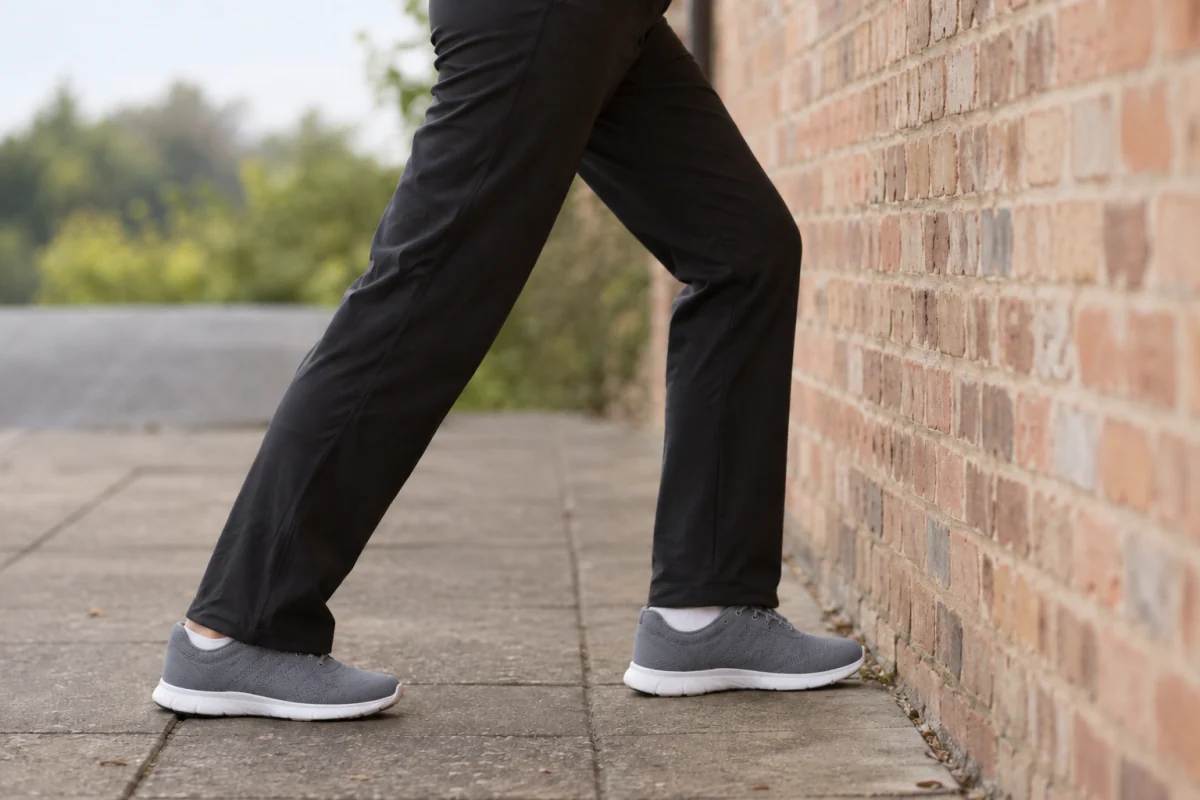
Before: the five-minute walk. After: walk five minutes, then hold each of these for 20 to 30 seconds per side. Stretching while the muscles are warm is comfortable and it is when it does the most good.
- Calf stretch. Hands on a wall, one leg back with the heel down, lean in until you feel the calf. Then bend the back knee slightly to reach the lower calf.
- Hip flexor stretch. Kneel on one knee, the other foot forward, push the hips gently forward until the front of the kneeling hip stretches.
- Hamstring stretch. Heel on a low step, leg straight, hinge forward from the hips with a flat back.
- Quad stretch. Standing, hold one ankle behind you, knees together, and push the hip forward.
- Glute stretch. Sitting or lying, cross one ankle over the opposite knee and pull the lower leg towards you.
If you sit at a desk all day, these overlap with the daily stretches we recommend for posture, and doing them on rest days helps the running too.
Shin splints, knee pain and side stitches
Shin splints
Aching along the inside of the shin bone during or after runs is usually from doing too much too soon on hard ground, often with old shoes. Change three things: run on grass or a treadmill for two weeks, go back one week in the plan, and shorten your stride so your feet land under your hips rather than out in front. If the pain is in one sharp spot, worse when you press on it, or you start limping, stop running and see a doctor. Mayo Clinic’s page on shin splints explains the difference between shin splints and a stress fracture, which needs proper rest.
Knee pain
Pain around or behind the kneecap that comes on during runs and eases with rest is common in new runners and usually reflects weak hips and glutes rather than a damaged knee. Add two sets of ten bodyweight squats, glute bridges and side-lying leg raises on non-running days. Shorten the stride. Avoid downhill running until it settles. Pain that swells the knee, locks it, or makes it give way is different and needs a doctor.
Side stitches
A sharp pain under the ribs, usually on the right, is a stitch. Nobody is fully sure what causes it, but it is more common after eating close to a run and when breathing is shallow. Slow to a walk, breathe out hard as the foot on the opposite side lands, and press your fingers into the spot. It passes in a minute or two. Eating earlier before sessions usually prevents it.
Missed a week? How to restart
- Missed one session: skip it and carry on. Nothing lost.
- Missed one week: repeat the last week you completed, then continue.
- Missed two weeks: go back two weeks in the plan.
- Missed a month or more: start again from week 1 but move through weeks 1 to 3 at one session each if they feel easy. Your heart and lungs remember faster than your legs do, and the legs are what get injured.
Illness is the same as a missed week. Do not run with a fever or a chest infection. A head cold with symptoms above the neck is usually fine for an easy session if you feel like it.
If the reason you missed weeks is that the plan simply did not fit your life, change the plan rather than quitting. Two sessions a week takes longer but still gets there. A good bridge while you sort it out is walking 30 minutes a day, which keeps the habit and the fitness alive with no impact.
Who should see a doctor before starting
Couch to 5K is built for people who have not exercised, and most healthy adults can start it tomorrow. Get a doctor’s advice first if you have heart disease, chest pain on exertion, uncontrolled high blood pressure, diabetes on insulin, a joint or bone condition, are pregnant, or have not exercised in years and are over 60. If you are carrying a lot of extra weight, running is still possible, but starting with four to six weeks of brisk walking first reduces the load on knees and shins, and a doctor or physiotherapist can help plan that. Nothing here is personal medical advice; a doctor who knows your history is the right person to confirm the plan suits you.
Frequently asked questions
How many days a week should a beginner run?
Three, with at least one rest day between each, for the first two months. Running on consecutive days is the most common way beginners develop shin and knee pain. Walking, cycling or swimming on the days between is fine and helps.
Is it normal to be out of breath in week 1?
Yes, but you should be able to speak in short sentences. If you cannot say “this is week one” out loud during a run interval, slow down. Being out of breath during the walk break as well means the run was too fast.
Can I do couch to 5K on a treadmill?
Yes. Set the incline to 1 percent to mimic outdoor effort and use the interval timer. Treadmills are kinder on the joints and take weather out of the equation. Do one or two of your later-week runs outside so the transition to a real 5K route is not a shock.
What if I cannot finish a week?
Repeat it. Nobody is counting the calendar. Many people take twelve to fourteen weeks to complete the nine-week plan and they finish just as fit. If you have repeated a week twice and it still feels impossible, check your pace first; it is almost always too fast.